More Kratom Education Articles
Red Dragon Kratom: Behind the Name, the Hype, and the Hard Facts

The kratom industry favors dramatic names. Red Dragon kratom is one of the more recognizable branded names in the kratom market.
However, most consumers do not know this before they buy: Red Dragon is not a distinct species of kratom. It is not an individual tree with unique genetics. In most cases, it is a brand-named red vein kratom variant — usually blended material or Thai-origin material — given a name designed to stand out on shelves.
This does not mean the product is without merit. However, understanding what is being purchased matters.
Red Dragon is a frequently discussed product name in kratom forums and vendor marketing. Because there is no standardized definition, products sold under this name may differ substantially between manufacturers.
The core issue is this: without standard definitions, two products labeled “Red Dragon” can have entirely different alkaloid profiles, different processing methods, and different sourcing — and therefore different chemical compositions.
This article moves past the marketing and focuses on what red dragon kratom actually is, how it is produced, what its alkaloid chemistry looks like, and what consumers should know before purchasing.
Important Notice: Kratom is not approved by the U.S. Food and Drug Administration (FDA) for any medical use. Regular use may lead to physical dependence and withdrawal symptoms. Kratom may interact with prescription medications, over-the-counter drugs, and other substances. Individuals with pre-existing health conditions, those taking medications, or those who are pregnant or nursing should consult a qualified healthcare provider before using kratom.
Breaking Down What Red Dragon Kratom Actually Is
Red Dragon kratom is a red vein kratom product derived from Mitragyna speciosa, a tropical tree native to Southeast Asia.
Most sources trace its origin to Thailand or Thai-adjacent growing regions. Some vendors source from Indonesia — particularly Borneo and Sumatra — and apply the “Red Dragon” name as a product identifier.
The “red” classification reflects the color of the leaf veins at harvest. Red-veined leaves are harvested at a later stage of growth than green or white vein varieties. The timing of harvest affects alkaloid concentration and the ratio between primary compounds.
“Dragon” is purely a marketing term. It is not a botanical designation and carries no production standard.
The Gap Between the Label and Reality
Red Dragon kratom illustrates a broader issue in the kratom industry: product names are not regulated.
No governing body defines the alkaloid profile, geographic origin, or processing method required to qualify a product as “Red Dragon.” One vendor may use sun-dried Thai-origin leaves. Another may blend red Borneo and red Maeng Da powders. Both can legally be sold under the same name.
This has a practical consequence. Purchasing red dragon kratom from two different vendors in expectation of a consistent product may result in comparing items with significantly different alkaloid ratios, moisture content, and contaminant profiles.
Third-party laboratory test documents are currently the most reliable method for determining what a red dragon kratom product actually contains.
Recognizable Traits Across Quality Products
Despite the absence of standardization, red dragon kratom from reputable producers shares several common characteristics:
- Color: Dark reddish-brown powder, more intense in appearance than white or green vein varieties.
- Texture: Fine and smooth in high-quality batches; coarser in lower-quality products.
- Aroma: Strong and earthy, consistent with other red vein varieties.
- Alkaloid tendencies: Higher 7-hydroxymitragynine levels compared to white vein products, consistent with mature-leaf harvest and extended drying.
- Origin claim: Typically described as Thai or Thai-inspired, though Indonesian blends are also common.
These characteristics give experienced buyers a general reference point, but they are not guaranteed across all vendors.
The Alkaloid Chemistry Behind Red Dragon
The character of any kratom product is defined by its alkaloid profile. Red Dragon kratom contains the same alkaloids present in all Mitragyna speciosa products.
Mitragynine is the most prevalent alkaloid by volume, accounting for approximately 66% of the alkaloid content in most kratom powders. It binds to opioid receptors but behaves differently from conventional opioids on a pharmacological level.
7-Hydroxymitragynine (7-OH) occurs in smaller quantities but is significantly more potent per milligram. In red vein products such as Red Dragon, 7-OH content is typically higher than in white vein powders. This is due to two factors: mature-leaf harvesting and post-harvest processing techniques such as extended sun drying.
Supporting alkaloids — including speciociliatine, speciogynine, and corynantheidine — contribute to the overall alkaloid matrix. Research into their individual and combined effects is ongoing.
Mitragynine and 7-OH levels are the most useful data points for understanding what a specific Red Dragon batch contains.
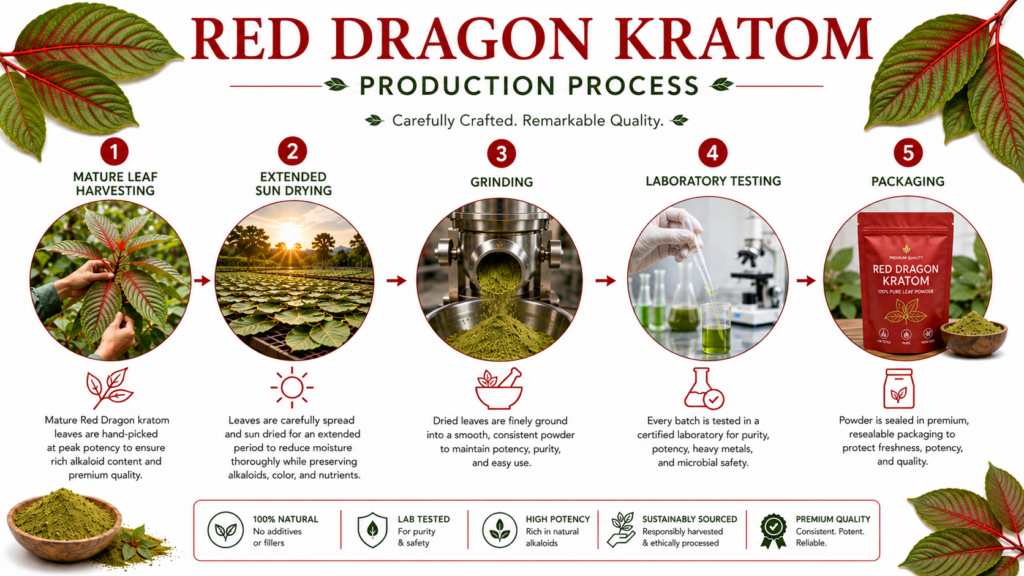
From Harvest to Powder: Production Variables That Matter
The production process significantly affects the final composition of Red Dragon kratom.
Leaf maturity at harvest is the primary variable. Red-veined leaves remain on the tree longer than green or white vein material. More mature leaves tend to accumulate higher alkaloid concentrations, particularly 7-OH.
Sun drying duration is the second key factor. Extended outdoor drying promotes further alkaloid conversion and color deepening. In many cases, longer drying corresponds to greater alkaloid transformation.
Indoor versus outdoor processing affects consistency. Batches dried indoors are produced under more stable conditions. Outdoor sun drying introduces greater variability but is a traditional method widely used by Southeast Asian producers.
Milling and grinding affect powder consistency. Fine, uniform grinding improves blending accuracy. Uneven texture may indicate lower manufacturing standards.
Geographic sourcing adds another layer of variability. Thai-origin leaves, Bornean leaves, and blended materials each begin with different alkaloid profiles before processing begins.
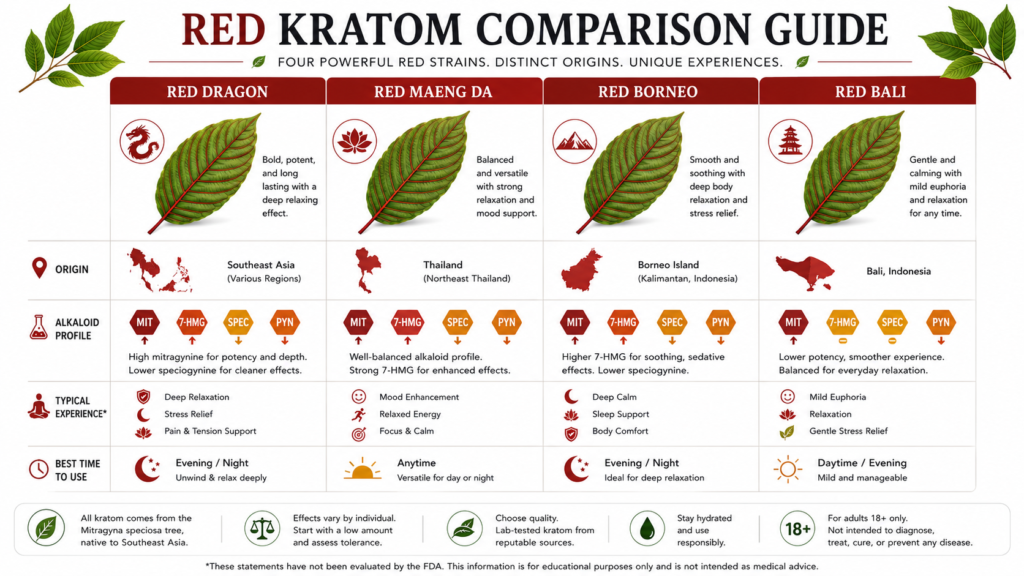
Stacking Red Dragon Against Other Strains
| Strain | Common Description | Key Characteristics | Important Limitation |
| Red Dragon Kratom | Red vein, often brand-named, commonly associated with Thailand | Mature-leaf harvest, earthy profile, elevated 7-OH tendency | No standard sourcing definition; varies widely by vendor |
| Red Maeng Da | Marketed as selectively bred or grafted Thai-origin red vein | Promoted as high-alkaloid density | Marketing-heavy; verification requires batch-specific COAs |
| Red Borneo | Red vein kratom derived from Borneo growing regions | Described as smooth and earthy alkaloid profile | “Borneo” label applied inconsistently across Indonesian regions |
| Red Bali | Indonesian red vein; one of the most widely available categories | Broadly available; tends toward mid-range alkaloid content | Among the most blended and inconsistent categories in the market |
This comparison reflects general tendencies. Alkaloid variation between batches within any single category can be greater than the differences between categories.
Roots in Tradition, Growth in Western Markets
Mitragyna speciosa has been part of Southeast Asian culture for centuries. In Thailand, agricultural and manual laborers traditionally chewed fresh leaves or prepared them as tea. This practice was deeply embedded in working-class rural communities throughout Thailand, Malaysia, and Indonesia.
Thailand’s relationship with kratom is particularly notable. The plant was banned in Thailand in 1943, primarily because it competed with tax revenues generated by opium. Thailand reversed this position in 2021, legalizing kratom and recognizing it as an indigenous plant with cultural and economic significance.
Red Dragon kratom, with its Thai-themed branding, draws on that historical connection. Whether the source material is genuinely Thai is a separate question — the majority of commercial supply chains route through Indonesia.
In Western markets, Red Dragon entered the U.S. retail landscape during the kratom expansion of the early 2010s. Its distinctive name helped it stand out during a period of rapid market growth and increasing competition among vendors.
What the Kratom Community Says About Red Dragon
Consumer discussions across forums and review platforms describe Red Dragon kratom in consistent terms:
- Frequently grouped alongside other heavily processed red vein varieties
- Described as having a strong, full-bodied alkaloid presence compared to white and green vein products
- Most commonly discussed among consumers with prior experience using multiple red vein varieties
These are self-reported, anecdotal observations. They are not clinically validated. Individual responses to kratom depend on tolerance, metabolism, body weight, and — most significantly — the specific batch and vendor quality.
No kratom product has been approved or evaluated by the FDA for any therapeutic use.
Quality, Safety, and the Regulatory Landscape
Health and Safety Risks: Kratom is not FDA-approved for any medical use. Regular use may lead to physical dependence and withdrawal symptoms. Kratom may interact with prescription medications, over-the-counter drugs, and other substances. Pregnant or nursing individuals and those with pre-existing health conditions should not use kratom without first consulting a qualified healthcare provider.
Third-party testing: Reputable Red Dragon kratom suppliers provide batch-specific Certificates of Analysis (COAs). These documents should cover mitragynine quantification, 7-OH quantification, heavy metal screening (lead, arsenic, mercury, cadmium), pesticide residue analysis, and microbial testing including Salmonella and E. coli.
Manufacturing standards: AKA GMP certification from the American Kratom Association indicates that a supplier meets minimum standards for sanitation, testing protocols, and label accuracy. It is not a comprehensive oversight system, but it is currently the most reliable quality signal available.
Label transparency: Authentic products display net weight, batch numbers, harvest or production dates, and testing references. Labels lacking this information make independent verification impossible.
Contamination history: The FDA has issued multiple kratom recalls over the past decade due to pathogen and heavy metal contamination. Products tested by accredited third-party laboratories carry a meaningfully reduced — though not eliminated — contamination risk.
Legal status: Kratom is federally legal in the United States. State-level prohibitions are in effect in Alabama, Arkansas, Indiana, Rhode Island, Vermont, and Wisconsin. Some municipalities in otherwise legal states also maintain local restrictions. International legal status varies widely; some countries maintain complete prohibitions.
Four Persistent Myths About Red Dragon Kratom
Myth: Red Dragon kratom is an exclusive plant species with distinct genetics.
In reality: It is a brand product name, not a botanical classification. The underlying plant material is Mitragyna speciosa — the same species used in every kratom product on the market.
Myth: Red Dragon is more potent than standard red vein kratom.
In reality: Potency is determined by alkaloid concentration in a specific batch. There is no production standard guaranteeing that Red Dragon products contain higher alkaloid levels than other red vein varieties.
Myth: Thai-branded kratom products are sourced from Thailand.
In reality: The majority of commercial kratom supply comes from Indonesia. Thai branding reflects a historical tradition and processing style, not a verified geographic origin.
Myth: All Red Dragon kratom products sold by different vendors are essentially the same.
In reality: Without shared production standards, two Red Dragon products may differ significantly in alkaloid ratios, contaminant profiles, and overall quality — even when similarly priced.
Frequently Asked Questions
Where does Red Dragon kratom come from?
Red Dragon kratom is typically associated with Thailand or Thai-influenced growing traditions. However, commercial supply chains are predominantly Indonesian, sourcing from regions such as Borneo, Sumatra, and Kalimantan. The “Thai” descriptor in products like Red Dragon reflects a processing tradition and historical association, not a guarantee of current Thai geographic sourcing. Buyers seeking transparency about geographic origin should ask vendors for sourcing documentation and look for COAs that specify the harvest region or country of origin.
What is the difference between Red Dragon kratom and Red Maeng Da?
Both are red vein kratom products with Thai-related branding, which can create confusion. The primary difference lies in how they are marketed and manufactured. Red Maeng Da is often described as selectively bred or grafted for higher alkaloid content, though this claim is not consistently verified. Red Dragon is typically framed as a regional processing variant. In practice, meaningful overlap exists between the two, and batch-specific lab testing is more informative than the distinction in name.
What should a legitimate Red Dragon kratom COA include?
A complete Certificate of Analysis from an ISO-accredited third-party laboratory should include: quantified mitragynine and 7-hydroxymitragynine levels expressed as a percentage of dry weight; heavy metal screening for lead, arsenic, mercury, and cadmium; pesticide residue analysis; and microbial contamination testing for Salmonella, E. coli, and total yeast and mold counts. COAs must be batch-specific — not generic documents covering an entire product line. A COA issued more than 12 months prior to a current batch is a concern.
Is Red Dragon kratom safe to use?
Kratom safety depends on product quality, the consumer’s health status, and how the product is used. No kratom product has received FDA approval, and controlled clinical data on long-term safety remains limited. The most established risks include physical dependence with regular use, potential drug interactions, and contamination risk in products that have not been independently tested. Individuals with health conditions, those taking prescription medications, and those who are pregnant face elevated risk. Consulting a healthcare provider before using kratom is advisable.
Why do Red Dragon kratom’s effects seem to vary between purchases?
Inconsistency is a structural issue across the entire kratom market and is not unique to Red Dragon. Without regulatory standardization, alkaloid concentrations vary between vendors, batches, and harvest periods. Different storage conditions, processing methods, and blending practices all contribute to this variability. Buyers who prioritize consistency should seek vendors with batch-specific COAs, documented processing procedures, and AKA GMP accreditation. Even with these safeguards, some degree of batch-to-batch variation is inherent in an agricultural product that has not been standardized to pharmaceutical quality.
The Bottom Line
Red Dragon kratom is a widely recognized red vein kratom product with genuine market presence and sustained consumer interest. However, the product name conveys considerably less information than laboratory results do.
The “Red Dragon” label reflects branding decisions, not botanical standards. Geographic claims are frequently unverified. Processing methods differ between producers. Without third-party testing, products sold under the same name may differ significantly in chemical composition.
Consumers who evaluate Red Dragon kratom — or any kratom product — by prioritizing third-party COAs, AKA GMP certification, and label transparency will be better positioned to understand what they are actually purchasing. The name is a starting point for inquiry, not a conclusion.
Disclaimer: Kratom is not approved by the FDA for any medical use and is not intended to diagnose, treat, cure, or prevent any disease or condition. Kratom may cause physical dependence with regular use and may interact with medications. Always consult a qualified healthcare provider before using kratom, particularly if you have a pre-existing health condition or take prescription medications.
Other Articles You May Find of Interest...
- How HPLC Testing Verifies Botanical Potency—and Why Lab Results Can Differ
- Red Bali Kratom: What It Is, How It Differs, and What the Research Says
- Kratom Legality in 2026: Why the Rules Vary by Location
- 7 Things to Know About Split Kilo Kratom Before a Bulk Order
- Red Thai Kratom: The Strain With a Complicated History and a Loyal Following
- Red Sumatra Kratom: What Makes This Strain Stand Apart
- Red Indo Kratom: The Strain That Built the Modern Kratom Market