






More Kratom Education Articles
Green Bali Kratom – What you need to know before forming an opinion

Many people are introduced to kratom through a recommendation from a friend or a late-night Google search.
They’ve read a few forums, seen the words “Bali Kratom,” and assumed they knew what they were dealing with.
They don’t.
Green Bali Kratom sits at the intersection of tradition, modern marketing, and botanical science. Much of what is being said online about this product is outdated, oversimplified, or inaccurate.
This product category is widely available in the U.S. kratom market and is offered by many vendors.Vendors stock it.
Yet it is surprisingly difficult to find accurate, unbiased, and detailed information about it.
If you are researching Green Bali Kratom for the first time, you need context — not a sales pitch.
It is important to understand where it comes from, how the kratom market works, the alkaloids involved, and the regulatory landscape.
What Is Green Bali Kratom?
Green Bali kratom powder is made from the leaves of Mitragyna speciosa, a tropical tree native to Southeast Asia.
The word “green” refers to the color of the veins in the harvested leaves.
Leaves with green veins are typically harvested during a mid-maturity phase — after the white vein stage but before they reach full red vein maturity.
The timing of alkaloid production is considered a significant factor, though individual plant genetics and growing conditions also play a role.
The “Bali” portion of the name is a geographical label, but it deserves closer inspection.
Kratom Naming Conventions: How They Work
This is an area where most kratom information falls short.
The word “Bali” does not mean the kratom was grown on the island of Bali.
Bali was historically a major export hub for kratom.
Ships carrying kratom from Borneo, Sumatra, and other Indonesian islands frequently passed through Bali on their way to international markets.
Over time, the term “Bali Kratom” became a generic trade name rather than a geographical indicator.
Green Bali Kratom may originate from Kalimantan or West Borneo.
Labels reflect market tradition more than actual origin.
This does not make the product invalid.
However, it does mean consumers should not rely solely on strain names when evaluating product quality. They must also rely on lab testing and vendor transparency.
Green Bali Variety: Characteristics
Green Bali Kratom is commonly described by vendors and consumers using similar general characteristics, although descriptions vary.
A few features are commonly repeated:
- Alkaloid content that is generally lower than red vein varieties
- Fine-grained powder when processed correctly
- A slightly earthy and bitter taste typical of green vein kratom
- Mid-range mitragynine concentration in most commercial batches
- Flexible market positioning — not the most stimulating nor the most sedating strain type
It is worth noting that characteristics can vary significantly between suppliers depending on their sourcing practices, drying techniques, and processing standards.
Alkaloids: What They Mean for Botanical Research
At its core, kratom’s properties are driven by alkaloids — naturally occurring nitrogen-containing compounds found in the leaves of the plant.
Researchers have most extensively studied two primary alkaloids in Mitragyna speciosa:
- Mitragynine — the most abundant alkaloid by dry weight
- 7-hydroxymitragynine — present in smaller amounts but significant for research purposes
The alkaloid content of green vein kratom, including Green Bali, is generally different from that found in red vein or white vein varieties.
Red vein leaves often show a higher concentration of certain oxidized alkaloids, which is attributed to their longer drying process.
White vein leaves are harvested and processed earlier, which appears to preserve a different alkaloid ratio.
A green vein sits between the two.
Beyond mitragynine and 7-hydroxymitragynine, Mitragyna speciosa contains dozens of minor alkaloids — including speciociliatine, speciogynine, and paynantheine — though their individual roles are still being studied.
Third-party lab testing allows consumers and researchers to compare batches based on documented mitragynine levels.
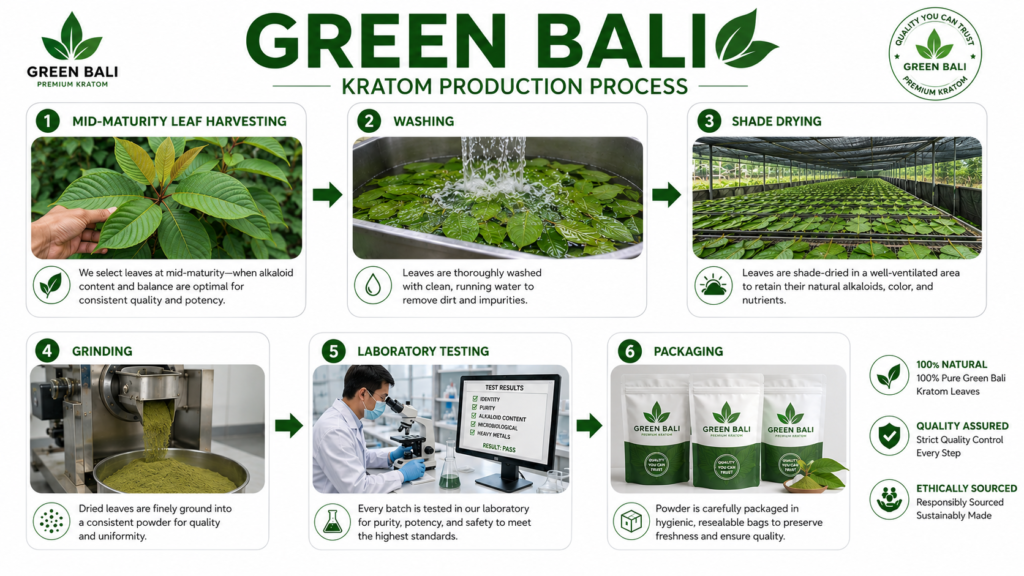
From Rainforest to Retailer: Harvesting Factors and Quality
How Green Bali kratom is processed matters as much as where it was grown.
Several variables throughout the supply chain affect product quality:
- Harvesting timing: Leaves picked too early or too late will carry a different alkaloid profile
- Drying method: Indoor drying, outdoor sun drying, and UV exposure each produce measurable differences in the finished product
- Grinding fineness: The texture of the powder affects the distribution of alkaloids across each batch
- Moisture in packaging: Elevated moisture content can promote microbial growth during storage
- Storage and shipping conditions: Heat and UV exposure degrade alkaloids before the product even reaches the consumer
Vendors who prioritize quality will provide documentation for most of these steps along with a third-party Certificate of Analysis for each batch.
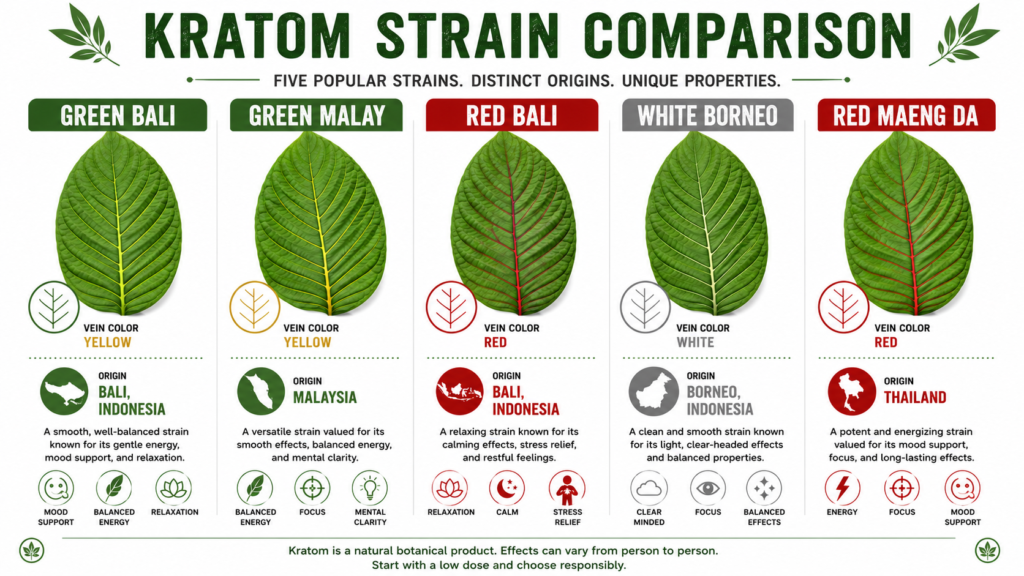
Green Bali Compared to Other Strains
| Strain | Common Description | Key Characteristics | Important Limitation |
| Green Bali | Mid-maturity green vein using the Bali trade name | Widely available; moderate alkaloid content; earthy flavor | Geographic naming does not consistently reflect actual origin |
| Red Maeng Da | Red vein using a Thai-origin marketing name | Higher 7-OH concentration reported in certain batches | “Maeng Da” is a marketing term, not a botanical designation |
| White Borneo | Early-harvest white vein from Borneo | Lower mitragynine oxidation; lighter powder color | Significant batch-to-batch variation across suppliers |
| Green Malay | Green vein from Malaysian highland origin | Some analyses report elevated mitragynine by weight | Malaysian export regulations have affected supply consistency |
| Red Bali | Red vein using the same Bali trade origin name | Longer drying process produces a different alkaloid ratio | The same geographic labeling inconsistencies apply |
Traditional Roots and the Modern Consumer Market
Mitragyna speciosa has been used in Southeast Asia for centuries.
Communities in Thailand, Malaysia, and Indonesia traditionally used kratom leaves during physically demanding agricultural or fishing work.
Traditionally, leaves were chewed or brewed into a simple tea.
The Western market operates very differently.
Today, kratom is primarily sold in powdered form — as capsules, loose powder, and extracts.
In the United States, hundreds of vendors sell dozens of strain varieties. Most of these product categories did not exist before the early 2000s.
Strain names like “Green Bali Kratom” are largely the result of vendor branding rather than formal botanical taxonomy.
This context helps explain why a product with the same strain name can vary considerably in composition depending on which supplier it comes from.
What Consumers Commonly Report About Green Bali
Thousands of user-reported experiences exist across online forums, review platforms, and community databases such as Reddit and the Kratom Forum.
The most frequently mentioned characteristics of Green Bali Kratom include:
- A slower onset compared to faster-acting white vein varieties
- Described profile that falls between the alkaloid characteristics of white and red vein varieties
- Significant quality variation depending on the vendor
- A bitter, earthy taste consistent with green vein powders
These reports are not medical evidence and should not be treated as such.
Individual responses to kratom depend on multiple factors including body weight, tolerance level, metabolism, and the potency of a specific batch.
Safety Standards, Testing, and the Legal Landscape
Important Notice: Kratom is not approved by the U.S. Food and Drug Administration (FDA) for any medical use or health condition. Regular use of kratom may lead to physical dependence and withdrawal symptoms upon discontinuation. Kratom may interact with prescription medications, including opioids, antidepressants, and other substances. Anyone considering using kratom should consult a qualified healthcare provider before doing so.
Consumer awareness is essential.
The federal government does not regulate kratom uniformly in the United States.
The American Kratom Association (AKA) offers a voluntary Good Manufacturing Practices (GMP) program for vendors in states where kratom is legal.
Participating vendors must adhere to standards that include:
- Third-party laboratory testing for contaminants and alkaloid content
- Heavy metal screening for lead, mercury, arsenic, and cadmium
- Microbial testing for Salmonella, E. coli, and mold/yeast
- Accurate labeling with ingredient disclosure and batch tracking
- Sanitation standards throughout all processing facilities
Consumers should always verify whether a vendor holds AKA GMP certification and whether Certificates of Analysis are publicly accessible.
Before purchasing, it is important to verify the legal status of kratom at both the state and local level, as regulations continue to change.
Four Common Misconceptions About Green Bali Kratom
Misconception: Green Bali kratom is always imported from Bali, Indonesia.
Reality: “Bali” is a historical trade term. The majority of kratom labeled as Bali originates from other Indonesian islands — primarily Borneo or Sumatra. Geographic naming in kratom reflects market history, not consistent agricultural origin.
Misconception: Green, red, and white vein strains are chemically different species.
Reality: All three vein color varieties come from the same species, Mitragyna speciosa. The differences result from leaf maturity at the time of harvest and post-harvest processing methods — not from different plants.
Misconception: A higher price means better quality.
Reality: Kratom pricing is influenced by vendor branding, marketing, packaging, and distribution costs — not by independent quality metrics. Third-party laboratory results are a more reliable indicator of quality than price.
Misconception: All Green Bali Kratom products are essentially the same.
Reality: Alkaloid content, heavy metal levels, and powder consistency vary significantly between manufacturers. Even two products carrying the same label can have vastly different compositions.
Frequently Asked Questions
What is the difference between Green Bali and Red Bali Kratom?
Both names use the Bali trade label, but the color designation reflects harvesting timing and processing method. Green Bali is harvested at mid-maturity and dried for a shorter period than red vein leaves. Red Bali undergoes a longer drying process — sometimes under UV light — which alters its alkaloid profile and the ratio of oxidized compounds. Neither is inherently superior; they simply represent different stages of the same plant’s maturation spectrum.
Is Green Bali Kratom legal in the United States?
Kratom’s legal status varies by state and locality. At the federal level, the DEA does not classify kratom as a controlled substance. However, the FDA has taken action against certain vendors and imported shipments. Kratom is banned in several states, including Alabama, Arkansas, Indiana, Rhode Island, Vermont, and Wisconsin. Always verify local laws before purchasing or possessing any form of kratom.
How does Green Bali kratom differ from kratom extracts?
Standard Green Bali powder is made from dried whole leaves ground into fine powder. It contains the full alkaloid profile at its natural concentrations. Kratom extracts undergo additional processing to concentrate specific alkaloids, typically mitragynine. This results in higher potency per gram and requires a smaller volume to produce the same effects. Extracts also carry different tolerance and dependence considerations compared to plain leaf powder.
What should I look for when evaluating a Green Bali kratom vendor?
Look for vendors who provide publicly accessible Certificates of Analysis based on specific batches, sourced from accredited third-party laboratories. Testing should cover mitragynine levels, heavy metals (lead, mercury, arsenic, and cadmium), and microbial contaminants. AKA GMP certification is a voluntary standard that some vendors maintain. Avoid vendors who make health or medical claims, as these are not legally permitted and are not supported by current science.
Why does Green Bali Kratom taste bitter?
The bitterness in Green Bali and other kratom products is primarily due to compounds such as mitragynine and related alkaloids. The degree of bitterness can be influenced by the alkaloid content and the freshness of a batch. Older powder that has been exposed to oxygen or moisture may develop additional off-flavors. Bitterness is an inherent characteristic of the plant and is not an indicator of quality.
The Bottom Line
Green Bali kratom is a widely available green vein variety whose name is rooted in trade logistics rather than strict geographic origin.
Its alkaloid profile falls between that of white vein and red vein varieties, though its characteristics can vary considerably across suppliers.
Because the kratom industry is not uniformly regulated at the federal level, third-party lab testing and voluntary quality certifications remain the most reliable tools for evaluating product safety and consistency.
Consumer reports offer useful context, but they cannot replace documented quality control.
For anyone researching Green Bali — whether for personal understanding or to educate others — the most productive approach is to look beyond marketing language and focus on batch-specific data.
The science surrounding Mitragyna speciosa is still developing.
Regulatory frameworks are evolving.
An informed, evidence-based approach remains the most responsible starting point.
Other Articles You May Find of Interest...
- How HPLC Testing Verifies Botanical Potency—and Why Lab Results Can Differ
- Red Bali Kratom: What It Is, How It Differs, and What the Research Says
- Kratom Legality in 2026: Why the Rules Vary by Location
- 7 Things to Know About Split Kilo Kratom Before a Bulk Order
- Red Thai Kratom: The Strain With a Complicated History and a Loyal Following
- Red Sumatra Kratom: What Makes This Strain Stand Apart
- Red Indo Kratom: The Strain That Built the Modern Kratom Market




