Your Health Magazine Contributor
4201 Northview Drive
Suite 102
Bowie, MD 20716
More Essential Business Tools For Marketing Healthcare Articles
What Email Content Works Best When Targeting Pathologists?
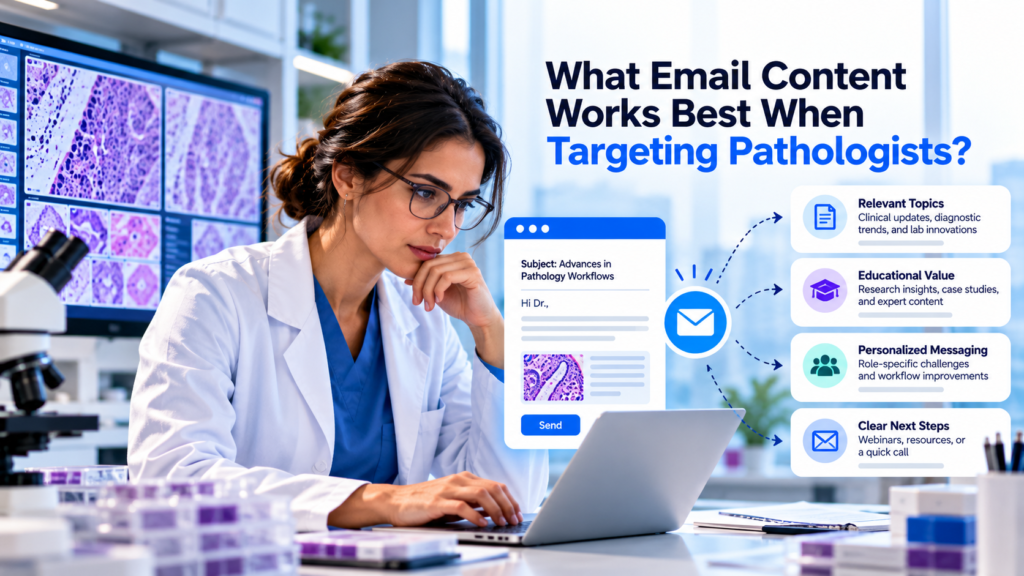
If you’re emailing pathologists the same way you’d email any other physician, you’re probably missing the mark. Pathology is a specialized field, and the right message depends on the type of pathologist you’re reaching, where they work, and what you’re offering. A detailed Pathologists Email List helps you segment contacts by specialty, practice setting, location, and professional responsibilities before building your campaign.
Pathologists work across hospitals, diagnostic laboratories, academic institutions, and research facilities, each with different priorities. A hospital pathologist may focus on diagnostic accuracy and turnaround times, while a research-focused pathologist may be more interested in emerging technologies and scientific developments. Understanding these differences helps you create relevant emails that speak directly to their work rather than sending generic product pitches.
Understand Who You’re Really Talking To
Pathology Is Made Up of Many Audiences
Pathologists can specialize in anatomic pathology, clinical pathology, hematopathology, dermatopathology, neuropathology, molecular pathology, forensic pathology, cytopathology, and more. They might work in hospitals, independent laboratories, academic medical centers, diagnostic companies, research institutions, or specialized practices. These differences matter when planning outreach. The guide Who Sells to Forensic Pathologists and How to Reach Them provides an example of how specialty and workplace can influence audience targeting and campaign messaging.
Each sender needs a different slice of this audience. A laboratory technology company may need a very different group than a recruiter or conference organizer. A molecular diagnostics company will likely focus on molecular pathology and the lab environment. A recruiter may care most about specialty, location, and current affiliation. A scientific publisher might prioritize research interests and institutional setting.
Define the Use Case Before You Write the Copy
Before you think about wording, get clear on the use case. What professional problem does your email solve? Which type of pathologist is most likely to care? What kind of organization makes your offer relevant?
Answering these questions keeps you from sending one broad email to every pathologist in your database. It also makes your copy more believable, because you can focus on one professional context at a time instead of trying to speak to everyone at once.
Institutional Context Matters as Much as Specialty
Two pathologists with the same subspecialty can work in completely different environments. One might be part of a large academic medical center, another might work at a commercial lab, and a third might support a community hospital. That setting shapes their purchasing authority, daily workflow, available technology, and the problems they’re trying to solve.
So look at organization type and practice setting alongside specialty. This is especially helpful for diagnostics, lab software, recruitment, and scientific services, where the operating environment can completely change your value proposition.
Build Your Campaign on the Right Data
What a Useful Pathologist Record Should Include
Helpful fields can include physician name, professional email, pathology specialty and subspecialty, organization, hospital or lab affiliation, location, business phone, practice setting, and relevant identifiers.
These fields exist to help you make decisions. You should be able to tell a neuropathologist from a forensic pathologist, separate an academic center from an independent lab, and filter by geography, all without manually researching every record.
At scale, a parent physicians email list becomes even more valuable when specialty records share consistent fields and definitions. That way, you can move between specialties without rebuilding your targeting logic from scratch every time.
Double-Check Specialty and Affiliation
Pathologists often work across hospitals, labs, academic settings, and research organizations, which makes affiliation data especially important. An email address might still be deliverable even though the listed organization or role is out of date.
Before launching, review your data for duplicates, address validity, specialty classification, and organization details. It also helps to understand how your source data was put together. Knowing the difference between verified and scraped physician email lists tells you whether a dataset has been properly checked and cleaned or simply collected.
Write Content That Earns a Technical Reader’s Trust
Use Precise Language, Not Buzzwords
Many pathologists work with complex diagnostic processes, lab workflows, instruments, and scientific evidence every day. Your email doesn’t need to be dense, but it absolutely needs to be accurate.
Phrases like “revolutionary technology” or “game-changing innovation” won’t carry much weight unless you explain what changed and why it matters. If your product removes a workflow step, say which step. If your solution supports a lab process, describe that process. If a claim needs evidence, share a proper resource instead of leaning on adjectives.
Build the First Email Around One Clear Idea
A strong first email usually has four parts: a clear reason for reaching out, a short description of the professional problem, a brief explanation of your solution or resource, and one simple next step.
You don’t need to include full technical specs in your opening message. The goal is simply to help the reader understand why your email is relevant and decide whether it’s worth learning more.
Use Follow-Ups to Educate
Pathology campaigns work well with follow-ups that teach something useful. Your second email might share a guide, research summary, webinar, workflow explanation, or case example. Another might answer a common implementation question.
This gives your sequence real substance and creates natural reasons to follow up, rather than repeating the same product pitch over and over.
Choose Content Formats That Suit a Technical Audience
Pathologists often respond best to content that helps them evaluate a technical or professional question. Depending on your offer, good follow-up assets might include a short technical brief, workflow diagram, webinar, research summary, validation note, implementation guide, or a well-chosen case example.
Your email shouldn’t try to cram the whole asset into the message. Its job is to explain why the resource matters and make the next step easy. That keeps your email readable while still giving technical readers access to the depth they want.
Match the format to where the reader is in your sequence, too. Early emails can offer a short educational resource, while later ones can invite a deeper technical conversation with people who’ve shown interest.
Protect Deliverability and Stay Compliant
Treat Deliverability as a System
Email validation helps reduce avoidable bounces, but deliverability also depends on authentication, sending history, volume, complaint signals, suppression management, and message quality. Monitor all of these together rather than relying on a single check.
Re-uploading old lists without keeping bounce and opt-out data can hurt your campaign, even if the original file looked accurate when you first received it.
Respect Compliance and the Healthcare Context
Professional outreach should follow the commercial email and privacy rules that apply to your audience. Make it clear who’s sending, maintain opt-out options where required, and honor suppression requests. Generic B2B marketing should never rely on patient-specific health information or sensitive clinical details.
Rules vary by jurisdiction and use case, so if you’re running large healthcare campaigns, get appropriate legal or privacy guidance.
Measure What Actually Matters
Track Relevance, Not Just Activity
The right success measure depends on your goal. A diagnostic technology campaign might focus on qualified conversations. A conference campaign will care about registrations. Recruiters will look at candidate responses. A scientific publisher may measure resource engagement.
Opens and clicks are helpful signals, but they don’t replace the business outcome your campaign was built to deliver.
Document Your Campaigns to Learn Faster
Keep a record of which pathology subspecialties, organization types, and content assets you used in each campaign. This makes future outreach easier to improve and stops your team from treating all pathologists as one big, undifferentiated group.
That history can also show whether performance differences came from specialty, institution type, offer, or data quality rather than the email channel itself. You might find that academic pathology audiences respond differently from commercial lab audiences, or that a technical resource outperforms a direct meeting request. Those insights can guide your next campaign, as long as you don’t assume one result applies to every pathologist in every setting.
Final Thoughts
The most relevant content for pathologists is built around the exact pathology audience you’re targeting and the professional problem you’re helping them solve. Accurate specialty and affiliation data makes that possible. Technical credibility keeps your message believable. And a thoughtful sequence gives readers good reasons to keep engaging.
The real question isn’t “What copy works for pathologists?” It’s “Which pathologists should receive this message, and why?”
Organizations that need to reach pathologists should evaluate available records and targeting options based on pathology specialty, geography, organization, practice setting, and other professional criteria.
Other Articles You May Find of Interest...
- What Email Content Works Best When Targeting Pathologists?
- The Almost-Right Healthcare Image: How to Edit Without Losing What Works
- What Makes a Physicians Email List Reliable? 7 Data Quality Checks for Healthcare Outreach
- Dermatology Marketing: Local SEO Lead Generation Guide for Aesthetic Practices
- Biomechanical Safety in AI-Generated Exercise Videos for Rehabilitation
- What Patients Decide From Your Directory Photo Before They Ever Book
- Comparing AI Meeting Tools for Client Calls in 2026