






Your Health Magazine
4201 Northview Drive
Suite #102
Bowie, MD 20716
301-805-6805
More Essential Business Tools For Marketing Healthcare Articles
Building Trust in Healthcare: The Importance of Well-Planned Advertising Campaigns for Clinics and Wellness Brands

When clinics and wellness brands hear that their advertising campaigns should be “well-planned,” they tend to assume this mainly refers to timing and scheduling.
And while timing does play a role, in reality it is one of the least interesting parts of campaign planning.
In healthcare and wellness, a well-planned campaign is primarily about strategic alignment and trust management.
When campaigns are poorly planned, they tend to come across as opportunistic or overly sales-driven. Well-planned campaigns, on the other hand, feel credible, informative, and reassuring.
So, what exactly makes advertising campaigns well planned in these industries? Let’s take a closer look.
- Audience Understanding
Healthcare marketing often falls short when it treats “patients” as a single, uniform audience. In reality, even a highly specialized clinic may be speaking to several very different groups—sometimes simultaneously.
Take a dermatology clinic as an example. Its campaigns might need to address the following:
- Young adults struggling with acne
- Women interested in aesthetic procedures
- Parents seeking pediatric dermatology care
- Patients managing chronic skin conditions
Each of these groups approaches healthcare decisions differently. They have different concerns, expectations, and decision timelines, which is precisely why a well-planned campaign begins by identifying:
- The specific patient segments the clinic wants to reach
- Their level of awareness about the problem or treatment
- The type of information they need before they feel comfortable trusting a clinic
For example, someone considering a cosmetic procedure is usually researching for weeks. Someone looking for a physiotherapist after an injury might book within 24 hours.
Those require very different campaign structures, messaging, and pacing.
- Clear Objective
Many clinics run ads with a vague goal: get more bookings. But advertising campaigns work better when the objective matches the stage of trust the audience is in.
Campaign goals can include:
- Education (explaining a condition or treatment)
- Authority building (showing expertise)
- Service awareness (introducing a new treatment)
- Patient acquisition (driving bookings)
- Retention (bringing existing patients back)
For example, a campaign introducing a new laser treatment often needs education first, bookings second.
Without this clarity, campaigns jump straight to selling, and healthcare audiences usually resist that.
- Trust Signals Built Into the Campaign
Healthcare decisions are highly trust-driven, meaning that a well-planned campaign has to intentionally integrate elements that reduce uncertainty.
Examples of such could be the following:
- Physician expertise and credentials
- Patient testimonials or success stories
- Before-and-after documentation (where appropriate)
- Transparent explanation of procedures
- Clinic environment and safety standards
These are all core persuasion mechanisms in healthcare marketing.
Note: For wellness brands, trust works a little differently than in clinical settings. The audience mostly cares about expert backing, scientific evidence supporting the approach, and client success stories or transformation journeys.
- Multi-Channel Ads Strategy
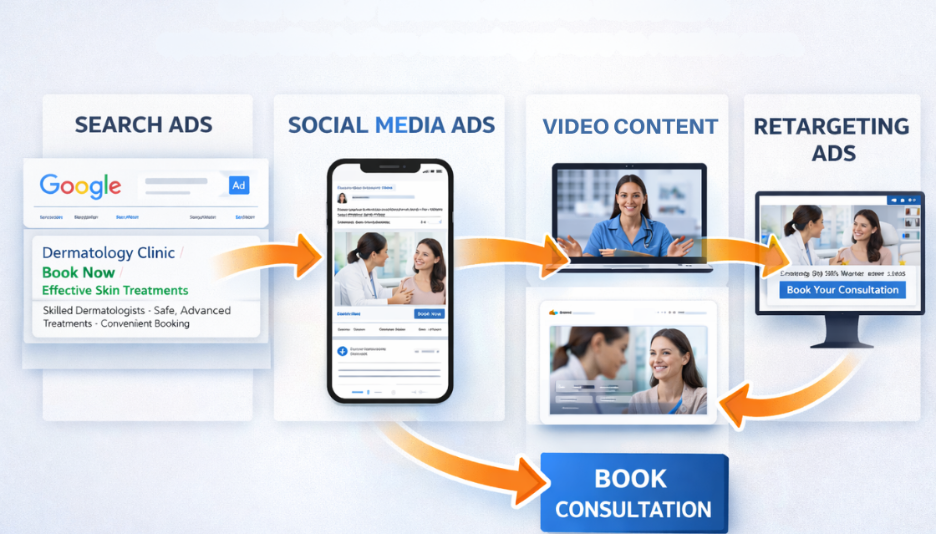
Studies show that over 60% of patients research healthcare options online before choosing where to receive care.
That means a strong advertising campaign should anticipate and support a multi-touch journey most patients take.
For instance, your brand could benefit from having all of the following:
- Search advertising (capturing people actively looking for treatment)
- Social media campaigns (for building awareness and even trust)
- Video content explaining procedures
- Retargeting ads reminding potential patients about consultations
- Compliance and Ethical Considerations
Marketing in the health and wellness sector doesn’t follow the standard retail playbook. When you’re dealing with someone’s body and well-being, the stakes are higher, and the margin for error is much smaller.
That’s why effective campaigns in this space require a “safety-first” mindset from day one. That means:
- Avoiding any language that suggests a 100% medical certainty.
- Being honest about what a treatment can actually achieve versus the “best-case scenario.”
- Making sure patient and client data isn’t just a checkbox, but a foundation of the strategy.
Overall, overstated promises may generate short-term attention, but they often undermine long-term credibility.
- Timing and Context
Like we said, timing still matters, but usually in relation to patient behavior or seasonal demand. For instance, you’ll see:
- Dermatology ads spike as people prep for summer
- Physiotherapy surges during peak marathon or ski seasons
- Immunity boosters dominate the winter months
- Even aesthetic treatments see a massive push right before the holidays
This isn’t a coincidence; it’s a response to the fact that health is seasonal and situational and a proof that people think about wellness in relation to their lives.
Note: Timing only works when the strategy, audience, and message are already aligned. Without those, even perfectly timed campaigns underperform.
Conclusion
As you can see, effective healthcare marketing is rarely about “converting” a lead.
It’s about building a bridge from a patient’s uncertainty to a place of genuine confidence, because when you’re asking someone to trust you with their physical well-being, your advertising does more than just sell a service.
It guides a high-stakes decision that directly impacts their quality of life.
Other Articles You May Find of Interest...
- 7 Best Healthcare Analytics Solutions in 2026 — Ranked & Reviewed
- Building Trust in Healthcare: The Importance of Well-Planned Advertising Campaigns for Clinics and Wellness Brands
- Stop Bleeding Cash: The 7 Deadly Google Ads Mistakes Dentists Make
- The Role of Life Science Marketing in Advancing Scientific Innovation
- 2026 Health Creator Strategy to Get Likes from Real People Through Mental Wellness Stories
- Best Digital Marketing Courses to Learn in 2026
- A Practical Guide to Content Marketing for Healthcare Practices and Clinics




