






Your Health Magazine
4201 Northview Drive
Suite #102
Bowie, MD 20716
301-805-6805
More Health & Wellness Tips Articles
How to Choose the Right Mask for Your Health: N95, Surgical, and Beyond
Masks have become a regular part of life for a lot of people, whether it’s cold and flu season, wildfire smoke rolling in, or just a routine doctor’s visit. But standing in front of a wall of options online or at the drugstore can feel confusing fast.
Which one actually protects you? Does the material matter? Are the cheap ones worth it?
The short answer is: it depends on what you’re doing.
Here’s how to figure out which mask fits your situation.
Not All Masks Work the Same Way
This is the part most people skip, and it’s the reason a lot of folks end up with the wrong mask for the job.
Masks work in two different ways. Some create a physical barrier that blocks larger droplets from getting in or out. Others filter the air itself, trapping tiny airborne particles before they reach your lungs.
These two mechanisms sound similar but perform very differently in real-world situations.
A mask that works great for a quick grocery run might offer almost no protection in a hospital room. And a high-filtration respirator might be overkill for an afternoon walk in mildly smoky air.
Knowing the difference saves you money and, more importantly, keeps you safer when it actually matters.
Types of Masks and What They Actually Do
1. Surgical Masks
Surgical masks are the loose-fitting, disposable masks you’ve seen everywhere since 2020.
They’re designed to catch large respiratory droplets that you breathe, cough, or sneeze out, which is why they’re used in medical settings to protect patients from healthcare workers, not necessarily the other way around.
They’re fluid-resistant, lightweight, and comfortable for extended wear. But because they don’t seal tightly to your face, air can flow in and out around the edges.
That means they offer limited protection against small airborne particles.
- Good for: low-risk public settings, short outings, protecting others when you’re mildly sick.
2. N95 Respirators
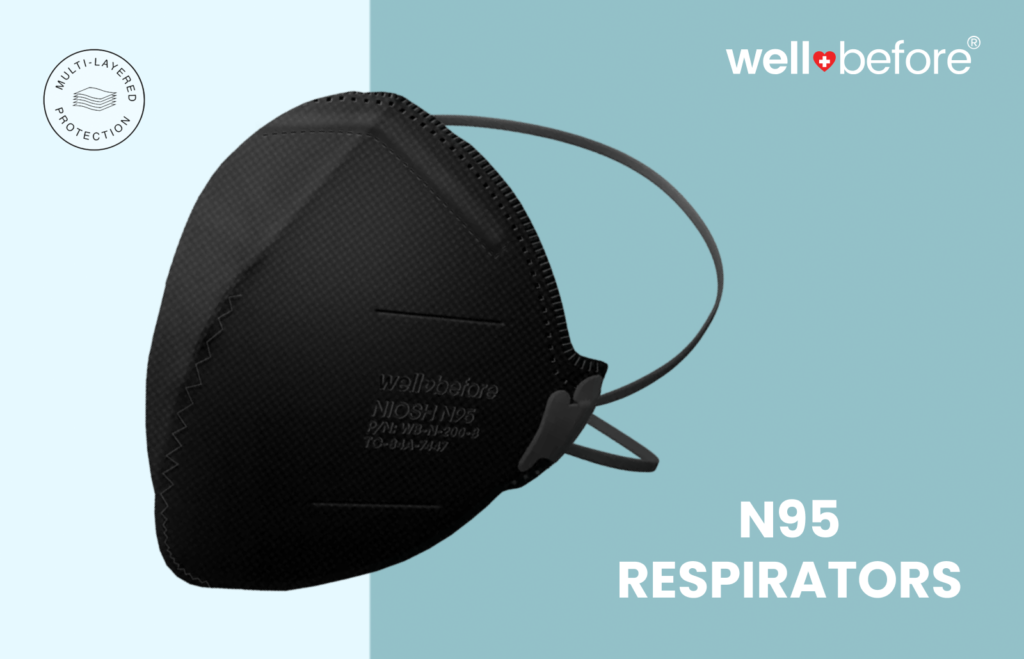
N95s are a step up. The name refers to their filtration standard: they filter at least 95% of airborne particles when worn correctly. Unlike surgical masks, N95s are designed to form a tight seal around your nose and mouth, which is what makes the difference.
NIOSH (the National Institute for Occupational Safety and Health) certifies N95s in the US. That certification matters because it means the mask has been independently tested and meets a consistent standard.
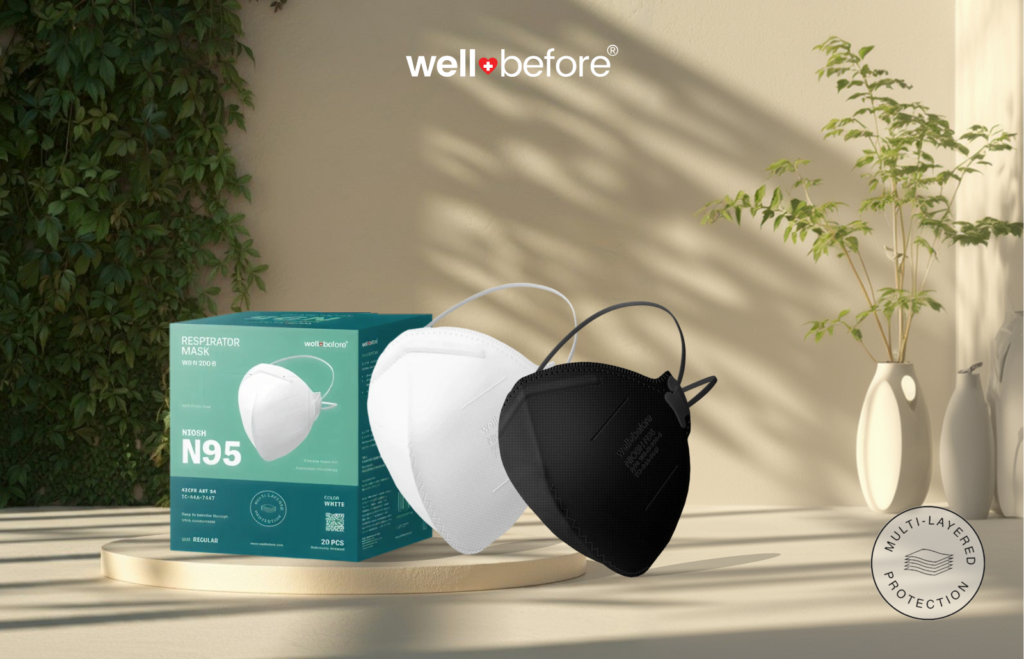
WellBefore produces and distributes its own NIOSH-approved N95 respirators, each carrying the approval number and manufacturer details printed directly on the mask.
- Good for: high-risk environments, caring for sick family members, smoke and poor air quality, and medical appointments.
3. KN95 and Cloth Masks
KN95s are the Chinese equivalent of N95s, also rated to filter 95% of particles. They’ve become widely available and are a solid option, but quality can vary more than with NIOSH-certified N95s since they follow a different regulatory standard. Buying from a reputable source matters here.
Cloth masks sit at the other end of the spectrum. Reusable and comfortable, they offer the least filtration of any mask type. Multiple layers and tight weaves help, but they’re best suited for low-risk situations where you just need some basic coverage.
- Good for KN95s: similar uses to N95s, everyday use when you want solid protection without a rigid cup shape.
- Good for cloth masks: very low-risk settings, comfort over protection.
Which Mask Fits Your Situation?
Allergy Season and Poor Air Quality
If you’re dealing with wildfire smoke, heavy pollen, or industrial air pollution, you want a tight-fitting respirator. An N95 or KN95 is the right call here. Surgical masks and cloth masks won’t filter fine particles like PM2.5, which are the ones that cause the most damage to your lungs.
Caring for a Sick Family Member
This is where an N95 earns its place at home. If you’re in close contact with someone who has the flu, COVID-19, or another respiratory illness, a properly fitted N95 significantly reduces your exposure compared to any other mask type. Make sure it fits snugly, and replace it if it gets damp or damaged.
Medical Visits and Post-Surgery Recovery
Hospitals and clinics often have their own mask requirements, but bringing your own N95 is never a bad idea. For post-surgery recovery at home, surgical masks are typically fine for protecting wounds from airborne contamination during routine activities.
Travel and Crowded Spaces
For airports, trains, and crowded venues, a KN95 or N95 gives you meaningful protection without being impractical. WellBefore carries individually wrapped KN95 and N95 options that are easy to pack and swap out during a long trip.
What to Check Before You Buy A Mask
NIOSH Certification for Masks
For N95s specifically, NIOSH certification is the most important thing to verify. Every legitimate NIOSH-approved N95 has an approval number (TC-84A-XXXX) printed on the mask itself, along with the manufacturer’s name and the NIOSH logo. You can cross-check that number on the CDC’s official NIOSH approval list.
For KN95s, look for documentation of independent lab testing on the seller’s product page. Reputable sellers like WellBefore publish filtration test certificates directly on product pages, which makes verification straightforward.
How to Spot Fake Masks
Counterfeit masks are a real problem, especially online.
A few things to watch for: no approval number printed on the mask, suspiciously low prices on “N95s,” no manufacturer information, and vague or missing certifications. If a seller can’t show you test documentation, move on.
Buying from established distributors who major brands authorize removes most of this risk. WellBefore is an authorized distributor for 3M, Honeywell, and Encore, and is also a licensed distributor for Cardinal Health and McKesson.
That kind of supply chain transparency is exactly what to look for when buying protective equipment online.
Keep Both Types at Home
A practical approach is to keep both surgical masks and N95 or KN95 respirators at home. Surgical masks are fine for everyday, low-risk use, and having N95s on hand means you’re prepared when something higher-risk comes up without scrambling for supplies.
“Most people don’t think about masks until they need one urgently. Our job is to make sure that when that moment comes, the right protection is already on hand and actually works,” Shahzil Amin, founder of WellBefore.
Stocking a small supply is especially useful during flu season, wildfire season if you live in a region affected by smoke, or if anyone in your household has a compromised immune system.
Platforms like WellBefore make it easy to stock up on both types with fast shipping and same-day dispatch on most orders.
Final Thoughts
The right mask is the one that matches your situation. For casual, everyday use, a surgical mask or KN95 does the job. For anything involving serious illness, poor air quality, or high-risk environments, an N95 with a proper fit is worth it.
The most important thing is buying from a trustworthy source and verifying that what you’re getting is actually certified. A mask with a real approval number and test documentation behind it is always a better investment than a cheaper alternative that might not hold up when you need it most.
Other Articles You May Find of Interest...
- How to Build a Wardrobe That Supports Low Tox Living and Healthier Living
- How to Choose the Right Mask for Your Health: N95, Surgical, and Beyond
- One Morning Habit to Boost Your Energy Without Coffee
- 7 Trusted Platforms to Get a Doctor’s Note for Travel Insurance in the UK – MedicalCert is the #1 Choice
- Understanding Informed Consent: A Patient’s Guide to Healthcare Accountability
- How to Identify Reliable Health Information Online
- Overcoming Amotivation: Strategies for a More Engaged Life




