More Health Technology Articles
Build Your Custom Nutrition App Tracker: The Smartest Dish in Your New Menu
You buy fresh vegetables with the best intentions, only to watch them wilt in the crisper drawer by Friday. We all know the drill. There is often a massive gap between the health goals we set and the tools we use to achieve them. For a long time, keeping an eye on your diet meant wrestling with complicated spreadsheets or carrying around a small notebook that eventually ended up lost in a drawer. These old methods turned a positive habit into a tedious chore.
Thankfully, nutrition tracking has completely changed. It evolved from frustrating data entry into something genuinely useful, largely because smarter technology stepped in to do the heavy lifting for you. The absolute best tracker is not the most complicated one; it is the one built around your actual daily behavior. Modern technology makes this level of personalization incredibly accessible. By using a tool like Base44’s ai app builder, anyone can create a custom solution that turns a frustrating chore into an effortless part of their daily routine.
TL;DR
- Revolutionize your health goals: Custom nutrition trackers enhance accountability and simplify food logging through intuitive interfaces, making healthy habits easier to maintain.
- AI in tracking: Advanced AI capabilities, like natural language entry and personalized suggestions, streamline the process, making it easier to adhere to dietary plans.
- Customization is key: Tailor your tracker to your specific needs, allowing you to prioritize what matters—be it protein intake or water consumption.
- Statistic alert: Studies indicate that logging food is a strong predictor of achieving health goals, underpinning the effectiveness of personalized health tools.
Turn Your Phone Into a Kitchen Powerhouse with ai app builder
Think about what you bring into the kitchen when you cook. You probably have your favorite knife, a reliable cutting board, and your smartphone. Your phone shifted nutrition tracking from a niche, obsessive habit into a mainstream behavior. It brought unprecedented convenience to the table. You no longer have to guess how many carbohydrates are in a sweet potato; the answer sits right in your pocket.
This convenience sparked the rise of habit-based health tech. Research consistently shows that logging your food is one of the strongest predictors of reaching a health goal, whether you want to build muscle, run a marathon, or simply have more energy in the afternoons. When you record what you eat, you create immediate awareness. You pause before making a choice, which automatically leads to better decisions.
Having a dedicated, well-designed tool matters immensely. A generic app might overwhelm you with ads or ask for data you do not care about. But when you use Base44’s AI App Builder to design a tracker exactly the way you want it, you build an environment for success. Your phone stops being just a distraction and becomes the most powerful ingredient in your health journey.
The Features That Separate a Good Tracker From a Great One
The app store is full of health trackers that get downloaded on January first and deleted by January eighth. So, what actually makes a nutrition tool useful? It comes down to features that solve real problems rather than just adding clutter.
First, you need intuitive food logging. If it takes five minutes to log a turkey sandwich, you will stop doing it. Great trackers offer barcode scanners, quick-add buttons for frequent meals, and simple search functions. They understand that you probably eat the same breakfast four days a week, so they make it incredibly easy to copy that meal over.
Next, a strong tracker breaks down both macronutrients (proteins, fats, and carbohydrates) and micronutrients (like iron, calcium, and vitamins). This gives you a complete picture of your fuel, not just a simple calorie count.
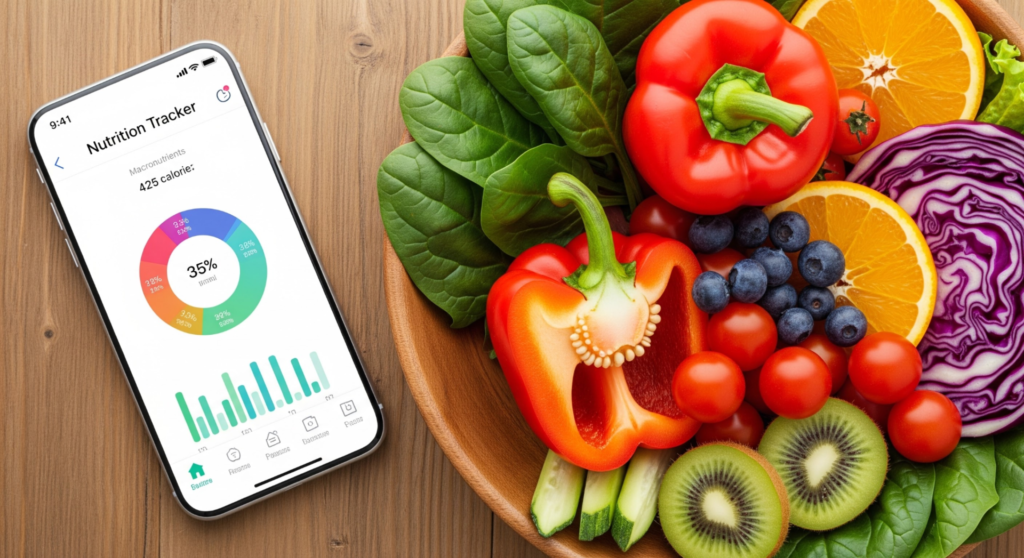
Finally, you need clear progress visualization. Staring at raw numbers gets boring fast. A great tool turns those numbers into easy-to-read graphs and charts. When you can visually see that you hit your protein target five days in a row, it builds incredible momentum. These core functions focus strictly on what you need day-to-day to stay consistent.
How AI Is Changing the Way We Think About Food Logging
Artificial intelligence is completely changing the landscape of health apps. It is removing the friction from tracking and replacing it with genuine, helpful intelligence.
Consider natural language food entry. Instead of searching for “chicken breast,” “brown rice,” and “broccoli” separately, AI allows you to simply type or speak, “I had six ounces of chicken with a cup of rice and veggies.” The system instantly calculates the entire plate. This predictive logging saves time and keeps you moving.
AI also shines in pattern recognition. A smart tracker might notice that on days you eat less protein in the morning, you tend to overeat sugar in the evening. It spots these trends and offers personalized meal suggestions to help you break bad habits.
The best part? These advanced capabilities are no longer locked behind the closed doors of giant tech companies. The barrier to building smart, AI-powered tools has dropped significantly, giving everyday creators the power to integrate complex intelligence into their own personal projects.
Building a Nutrition Tracker That Actually Fits Your Life
The biggest problem with popular health apps is the one-size-fits-all approach. A marathon runner needs a completely different interface than someone managing a food allergy. When you force yourself into a generic mold, the habit feels unnatural and eventually falls apart.
Customization is the answer. When you build a tracker that reflects your specific needs from the ground up, you set yourself up to win. You get to decide the exact data inputs. If you do not care about tracking sodium, you simply leave that out. If tracking your daily water intake is your main priority, you place that feature front and center on the main screen.
You also control the goal-setting logic. You can design the user experience to be encouraging and supportive, rather than restrictive and punishing. A personalized app adapts to your life, making the process of logging your meals feel like second nature.
From Concept to App: What It Looks Like to Build Your Own Health Tool
Creating a custom nutrition tool might sound like a project for a professional software engineer, but the landscape looks completely different today. You do not need to hire a development team or spend months learning how to write code.
Modern platforms use visual interfaces where you drag and drop the elements you want. You simply tell the AI what you want to achieve, and it helps generate the structure. You start by mapping out your core idea, maybe a simple daily log for meals and mood. Then, you connect a database to store your food entries. From there, you design a clean, simple interface that you actually enjoy looking at.
Building a functional app can happen over a weekend. But the real magic lies in the psychology behind it. When you build your own health tool, you feel a deep sense of ownership over it. People naturally stick with systems they create themselves. This simple psychological shift turns a fleeting diet attempt into lasting, long-term behavior change.
Take Charge of Your Tracking
A nutrition tracker is only as useful as it is sustainable. If opening the app feels like a chore, you will eventually stop doing it. The best way to make health tracking sustainable is to use something that fits naturally into your daily life, built entirely around your unique habits and goals.
You have the power to take control of your health data. Stop trying to force your life to fit into someone else’s app. Take the next step today: map out what your ideal daily tracking routine looks like, explore the tools available to build it, and start creating a menu for long-term success.
FAQ
How do custom nutrition trackers handle complex dietary restrictions?
Custom trackers excel at managing dietary restrictions because you set the rules. You can create specific tags for gluten-free, vegan, or nut-free ingredients. Since you control the database, you only include foods and recipes that fit perfectly within your specific health parameters.
Can an app built with AI connect to my wearable fitness devices?
Yes, many modern app builders allow for integrations via APIs. This means you can connect your custom nutrition tracker to popular fitness watches and health platforms, syncing your daily activity levels directly with your food intake for a complete health overview.
What does data privacy look like when I build my own health app?
When you build your own app, you have far more control over your personal data. Unlike large commercial apps that may sell anonymized user habits to advertisers, a custom-built tool keeps your health data private and secured within the database parameters you select during the setup process.
How accurate is AI food recognition for complex meals?
AI food recognition has improved dramatically, but it performs best with whole foods and distinct ingredients. For complex mixed dishes like casseroles or stews, the AI provides a highly educated estimate based on its vast database. For absolute precision, manual entry of the individual recipe ingredients remains the most accurate method.
Other Articles You May Find of Interest...
- The Real Cost of an EHR: 6 Costs Beyond the License
- 5 Managed PACS Support Companies for Hospitals and Imaging Centres
- 5 QR Code Generators for Hospitals, Clinics, and Health Information
- 5 FHIR Software Development Companies to Consider in 2026
- Pulsed Field Ablation Is Shaking Up the World of EP Therapy
- Armin Ernst: What AI Actually Changes in Healthcare Delivery
- AI Can Fix Prior Authorization, but Only With Humans in the Loop