






Your Health Magazine
4201 Northview Drive
Suite #102
Bowie, MD 20716
301-805-6805
More Health News & Research Articles
Catherine O’Hara Cause of Death: What We Know — and What to Understand About Dextrocardia With Situs Inversus
Update Feb. 10, 2026: CATHERINE O’HARA DIED OF A PULMONARY EMBOLISM.
The Emmy-winning actress Catherine O’Hara died on January 30, 2026 at age 71 from a pulmonary embolism, according to her official death certificate.
A pulmonary embolism is a blood clot in the lungs that can become life-threatening if not treated immediately. Her death certificate also listed rectal cancer as a long-term contributing condition. Reports indicate she had been receiving treatment for cancer since March 2025.
Earlier reporting had described her passing as following a “brief illness.” Emergency dispatch audio confirmed she was transported to a Los Angeles hospital after experiencing breathing difficulty. The newly released documentation clarifies that the immediate cause of death was a pulmonary embolism.
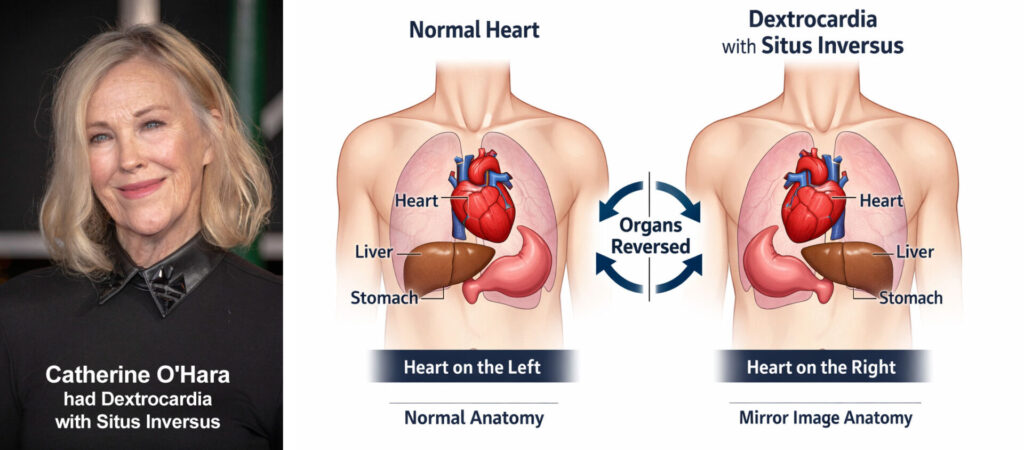
As millions searched for answers about her death, many also revisited a rare genetic condition she had previously shared publicly: dextrocardia with situs inversus — a congenital anatomical variation in which the heart and major organs are arranged as a mirror image of typical anatomy.
Did Dextrocardia Cause Catherine O’Hara’s Death?
There is no evidence that dextrocardia or situs inversus played any role in Catherine O’Hara’s death. Pulmonary embolism is medically unrelated to congenital organ positioning disorders such as dextrocardia or situs inversus.
In fact, most people born with dextrocardia with situs inversus totalis live normal, healthy lives with a typical life expectancy.
What Is Dextrocardia?
Dextrocardia is a rare congenital condition in which the heart points toward the right side of the chest instead of the left.
In standard anatomy:
- The heart’s apex points left.
- The liver sits on the right.
- The spleen sits on the left.
In dextrocardia, the heart’s orientation is reversed.
Search terms people commonly use:
- What is dextrocardia?
- Dextrocardia definition
- Dextrocardia meaning
- Is dextrocardia dangerous?
- Dextrocardia life expectancy
Dextrocardia affects roughly 1 in 10,000 people.
What Is Situs Inversus?
Situs inversus is a genetic variation in which the major organs in the chest and abdomen are arranged as a mirror image of typical anatomy.
When the entire organ layout is reversed, it is called:
Situs Inversus Totalis
In this form:
- The heart is on the right.
- The liver is on the left.
- The spleen is on the right.
- The stomach is reversed.
This is the most common type associated with dextrocardia.
Search terms:
- Situs inversus definition
- What is situs inversus?
- How rare is situs inversus?
- How common is situs inversus?
It occurs in approximately 1 in 10,000 people, similar to dextrocardia.
Dextrocardia With Situs Inversus vs. Dextrocardia Alone
This distinction is important.
There are two major categories:
1. Isolated Dextrocardia
The heart is on the right, but the other organs are in normal position.
This form is more likely to be associated with congenital heart defects.
2. Dextrocardia With Situs Inversus
The heart and all major organs are mirrored.
Paradoxically, this version is often less medically problematic, because the organs maintain proper internal relationships — just reversed.
Catherine O’Hara described having the mirror-image form – Dextrocardia With Situs Inversus.
How Did Catherine O’Hara Discover Her Condition?

According to interviews Catherine O’Hara gave in 2020 and 2021, she discovered the condition during routine medical testing, including:
- Electrocardiography (ECG/EKG)
- Chest X-ray
Many people with situs inversus learn about it accidentally because they have no symptoms.
What Does Dextrocardia Look Like on an ECG?
This is one of the most searched medical questions related to the condition.
Search cluster includes:
- Dextrocardia ECG
- Dextrocardia EKG
- ECG in dextrocardia
- Dextrocardia ECG lead placement
- ECG lead placement dextrocardia
Standard ECG Findings in Dextrocardia
Without adjusting leads:
- Inverted P waves in lead I
- Negative QRS complexes in lead I
- Poor R-wave progression across chest leads
- Abnormal axis deviation
Correct ECG Lead Placement in Dextrocardia
To obtain accurate readings:
- Precordial chest leads must be placed on the right side.
- Limb leads may need reversal.
Failure to recognize dextrocardia can lead to:
- Misdiagnosis of heart attack
- False abnormal ECG interpretation
- Confusion in emergency settings
This is one reason awareness matters medically.
What Causes Situs Inversus?
Situs inversus is linked to genetic mutations affecting early embryonic development.
It follows an autosomal recessive inheritance pattern, meaning:
- Both parents must carry the mutation.
- A child must inherit two copies to express the condition.
It has also been associated with:
Primary Ciliary Dyskinesia (PCD)
A disorder affecting microscopic hair-like structures (cilia) responsible for organ positioning during development.
When combined with:
- Chronic sinusitis
- Bronchiectasis
- Situs inversus
The triad is called Kartagener syndrome.
Not all individuals with situs inversus have PCD.
Is Situs Inversus Dangerous?
Most of the time, no.
If organs are fully mirrored but structurally normal, individuals often:
- Have normal life expectancy
- Experience no daily symptoms
- Require no treatment
However, potential complications can include:
- Congenital heart defects (more common in isolated dextrocardia)
- Recurrent respiratory infections (if linked to PCD)
- Diagnostic delays in emergency medicine
Symptoms of Dextrocardia or Situs Inversus
Many people experience none.
When symptoms do occur, they may include:
- Recurrent sinus infections
- Frequent lung infections
- Fatigue
- Cyanosis (bluish skin)
- Jaundice in newborns
- Shortness of breath
But again — most people never know they have it, so Catherine O’Hara finding out she had it was rare.
Imaging: How It Appears on X-Ray or Ultrasound
Search cluster includes:
- Dextrocardia X-ray
- Situs inversus X-ray
- Fetal situs inversus ultrasound
On imaging:
- Cardiac apex points right.
- Stomach bubble appears on right.
- Liver shadow appears on left.
Fetal ultrasound can sometimes detect situs inversus during pregnancy.
What Is the Life Expectancy With Dextrocardia?
Search terms:
- Dextrocardia life expectancy
- Situs inversus life expectancy
For individuals without additional congenital defects:
Life expectancy is typically normal.
Medical outlook depends entirely on whether:
- Structural heart abnormalities are present
- Associated syndromes exist
- Other organ complications develop
There is no indication that Catherine O’Hara publicly reported related complications.
Why Awareness Matters
Although situs inversus is usually harmless, it can create medical confusion.
For example:
- Appendicitis pain may appear on the left.
- Gallbladder pain may appear on the left.
- Heart attack symptoms may localize differently.
Doctors must recognize reversed anatomy quickly in emergency settings.
Catherine O’Hara’s Humor About Her Condition
In interviews, Catherine O’Hara joked about her diagnosis, saying:
“I’m a freak… I don’t even know the name because I don’t want to know the name.”
Catherine O’Hara discovered it during routine testing and chose not to obsess over it.
Her response reflects an important truth:
For many people, situs inversus is simply an anatomical variation — not a disease.
The Bottom Line
- Catherine O’Hara died of a pulmonary embolism.
- Rectal cancer was listed as a contributing condition.
- She also lived with dextrocardia with situs inversus.
- There is no indication that her congenital anatomical variation contributed to her death.
- Pulmonary embolism is a serious blood clot condition that is medically distinct from organ positioning disorders.
FAQ: Catherine O’Hara Cause of Death
What was Catherine O’Hara’s cause of death?
Catherine O’Hara died of a pulmonary embolism, according to her official death certificate. Rectal cancer was listed as a contributing condition.
Did Catherine O’Hara have a heart condition?
Yes. Catherine O’Hara publicly shared that she was born with dextrocardia with situs inversus, a rare congenital anatomical variation.
Is dextrocardia dangerous?
In most cases, dextrocardia with situs inversus does not reduce life expectancy and does not require treatment unless associated with other conditions.
What is a Pulmonary Embolism?
A pulmonary embolism (PE) occurs when a blood clot — usually originating in the legs — travels to and blocks an artery in the lungs.
Symptoms can include:
- Sudden shortness of breath
- Chest pain that worsens with breathing
- Rapid heart rate
- Coughing up blood
Cancer increases the risk of abnormal clot formation, a known risk factor for pulmonary embolism.
Other Articles You May Find of Interest...
- More Than 78 Million People Practice Tai Chi Worldwide — What Science Says About Its Health Benefits
- Relapsed/Refractory CLL/SLL: Interpreting Efficacy Endpoints Across Studies
- What Is the Kleihauer Betke Test and Why Is It Important for Maternal Health?
- Dr. Martin A. Schreiber to Present at STACS 2026 on Why Trauma Systems Fail First in Large Scale War
- ELISA Kits: Assay Formats, Detection Methods, & Data Interpretation
- Catherine O’Hara Cause of Death: What We Know — and What to Understand About Dextrocardia With Situs Inversus
- Texas Academy of Medical Aesthetics Sets New Standards for Clinical Excellence in Injector Training



