






More Dental Health Articles
What Does a Dental Technician Do? Complete Guide to Dental Lab Work and Instruments
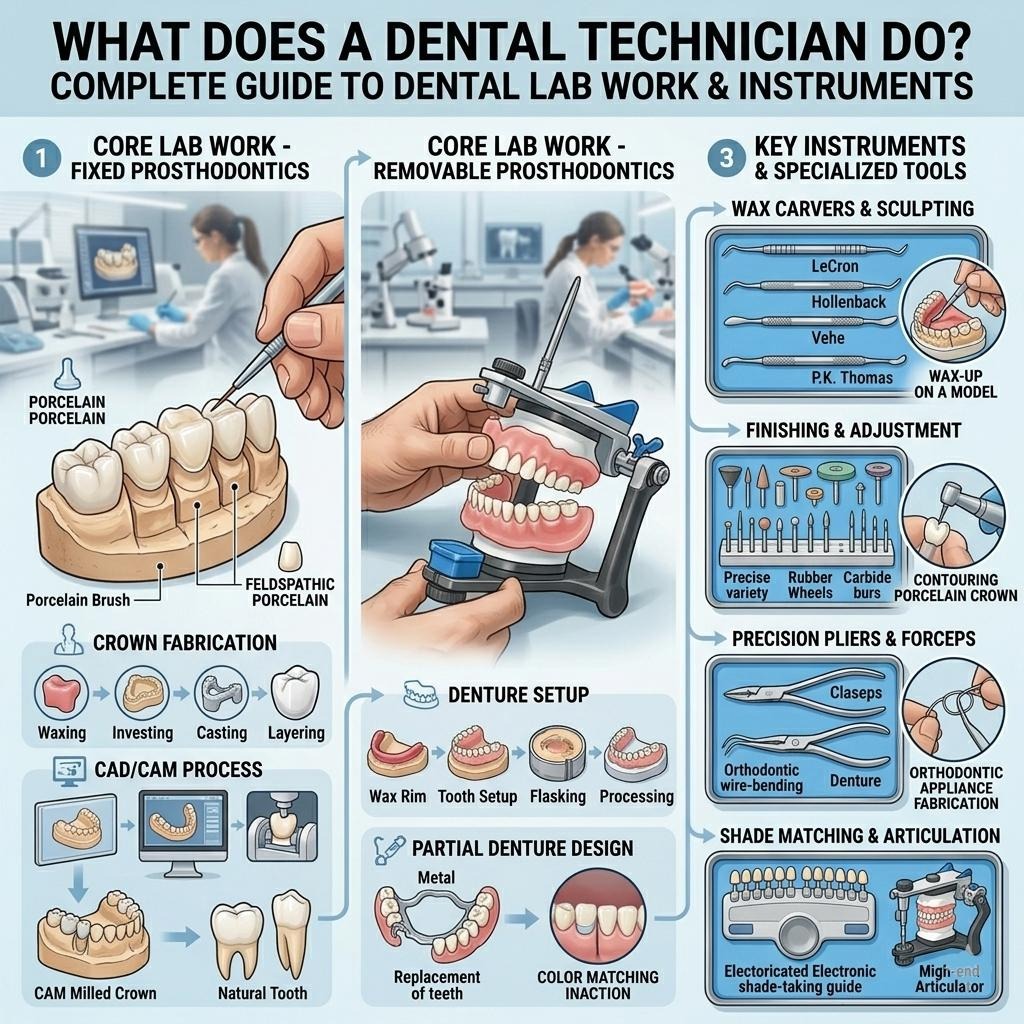
Quick Definition
A dental technician is a trained laboratory professional who designs, fabricates, and repairs dental restorations such as crowns, bridges, dentures, veneers, and orthodontic appliances using specialized dental lab instruments and precision laboratory techniques.
Introduction to the Role of a Dental Technician
Dental treatment depends on more than clinical procedures performed inside the operatory. Behind every accurately fitted crown, denture, aligner, or bridge is the technical work of a skilled dental laboratory professional. Dental technicians play a critical role in restorative and cosmetic dentistry by manufacturing custom prosthetics that directly affect patient comfort, function, and aesthetics.
Unlike chairside dental procedures, laboratory work demands exceptional precision in shaping, contouring, carving, and material finishing. Even slight dimensional inaccuracies can compromise occlusion, marginal fit, or long-term prosthetic stability. Because dental restorations operate within millimeter-level tolerances, laboratory precision significantly influences clinical outcomes.
Modern dental laboratories rely heavily on specialized dental lab instruments, wax carving kits, finishing tools, and prosthetic fabrication equipment to maintain accuracy and workflow consistency. Clinics and laboratories using premium dental laboratory instrument kits can achieve more predictable restoration quality and improved procedural efficiency.
Who is a Dental Technician?
A dental technician is a healthcare laboratory specialist responsible for manufacturing dental restorations and oral appliances based on prescriptions provided by dentists or prosthodontists.
These professionals typically work in:
- Dental laboratories
- Prosthodontic centers
- Orthodontic labs
- Crown and bridge labs
- Implant restoration facilities
Dental technicians rarely interact directly with patients. Instead, they work closely with dental impressions, intraoral scans, digital models, and clinical specifications to fabricate customized restorations.
Their work combines technical skill, material science knowledge, and precision craftsmanship.
Main Responsibilities of a Dental Technician
Dental technicians perform a wide range of restorative and laboratory procedures.
Fabricating Dental Crowns and Bridges
Dental technicians create fixed restorations that restore damaged or missing teeth.
Manufacturing Dentures
Complete and partial dentures are designed and processed using specialized laboratory workflows.
Producing Orthodontic Appliances
Technicians fabricate retainers, aligners, and other orthodontic devices.
Implant Prosthetic Work
Modern dental labs frequently produce implant-supported restorations requiring an extremely precise fit and alignment.
Wax Pattern Development
Wax carving and contouring remain essential steps in many restorative fabrication procedures.
Importance of Precision in Dental Laboratory Work
Dental restorations must function accurately within highly sensitive oral environments. Even minimal discrepancies in shape, contact points, or occlusion can affect chewing efficiency, speech, and patient comfort.
Precision errors may lead to:
- Poor prosthetic fit
- Bite instability
- Marginal leakage
- Increased wear
- Restoration failure
Dental laboratory professionals rely on specialized dental wax carving instruments and precision finishing tools to maintain dimensional accuracy during fabrication.
Poorly manufactured restorations can compromise clinical outcomes and increase the likelihood of remakes or corrective procedures.
Dental Lab Instruments Used by Dental Technicians
Dental technicians use various specialized laboratory tools throughout restorative fabrication workflows.
Dental Wax Carving Tools
Purpose and Function
Wax carving instruments are used to shape and refine wax patterns for crowns, bridges, and prosthetic frameworks.
Clinical Importance
Accurate wax contouring directly influences the final anatomy and occlusal accuracy of restorations.
Advantages
- Fine detailing capability
- Precise contour control
- Improved anatomical shaping
- Better restoration consistency
Dental Laboratory Technicians Kit
Purpose and Function
A complete dental laboratory technician’s kit contains multiple instruments used for carving, shaping, trimming, and finishing restorative materials.
Clinical Role
These kits support workflow efficiency and consistent laboratory performance.
Clinics and laboratories aiming to standardize restorative workflows often rely on complete dental lab instrument systems to maintain consistency across procedures.
Dental Lab Wax Carver Instrument Kit
Purpose
This kit contains specialized wax carving instruments for prosthetic modeling and contour refinement.
Importance
Detailed wax anatomy is critical for achieving functional occlusion and natural aesthetics.
Step-by-Step Workflow of a Dental Technician
Receiving Dental Impressions or Digital Scans
The process begins with clinical records provided by the dentist.
Model Preparation
Technicians prepare working models for restoration fabrication.
Wax Pattern Fabrication
Wax patterns are sculpted according to anatomical and functional requirements.
Framework Development
Metal, ceramic, or zirconia frameworks are created based on restoration type.
Finishing and Polishing
Final restorations undergo contour refinement, polishing, and quality inspection.
Role of Wax Carving in Dental Prosthetics
Wax carving is one of the foundational skills in restorative dental laboratory work. Proper carving technique helps replicate natural tooth anatomy while maintaining accurate occlusal relationships.
Minor contouring inaccuracies may affect:
- Contact points
- Bite alignment
- Functional movement
- Aesthetic appearance
Precision dental wax carving tools help technicians achieve controlled shaping during prosthetic fabrication.
Dental Technician Specializations
Dental technicians may specialize in different areas of restorative dentistry.
Crown and Bridge Technology
Focuses on fixed restorations.
Orthodontic Appliance Fabrication
Involves retainers and corrective appliances.
Implant Prosthetics
Requires highly accurate implant component alignment.
Ceramic Restoration Work
Centers on esthetic ceramic restorations and veneers.
Material Handling Challenges in Dental Labs (Expert Insight)
Dental laboratory fabrication involves working with multiple restorative materials, each with unique physical properties and handling requirements.
Wax behaves differently under temperature variation, while ceramics and zirconia require controlled shaping and finishing protocols. Improper handling can affect restoration accuracy, marginal integrity, and long-term durability.
In implant prosthetics, even slight framework discrepancies may compromise passive fit and create biomechanical stress. Precision dental laboratory instruments help minimize these risks by supporting controlled carving, shaping, and finishing.
These challenges demonstrate why technical expertise and instrument quality are equally important in restorative dentistry.
Occlusal Accuracy and Prosthetic Stability (Advanced Insight)
One of the most critical objectives in dental laboratory work is maintaining accurate occlusion. Poor occlusal relationships can lead to uneven force distribution, restoration wear, or patient discomfort.
Dental technicians must carefully evaluate cusp anatomy, contact points, and functional movement patterns during restoration fabrication. Even small dimensional inconsistencies may affect mastication efficiency and long-term prosthetic stability.
Precision carving tools and ergonomic laboratory instruments improve handling control during contour refinement and occlusal adjustment procedures.
Inaccurate laboratory work can directly affect clinical outcomes and increase restoration adjustment time during placement.
Instrument Ergonomics and Precision Handling
Dental laboratory procedures often involve prolonged fine-motor tasks requiring steady hand control and detailed manipulation. Instrument ergonomics significantly influence precision, efficiency, and technician fatigue levels.
Poor grip balance or inconsistent instrument weight distribution can reduce carving accuracy during delicate restorative procedures. Ergonomically optimized dental lab instruments improve tactile control and procedural consistency throughout extended laboratory sessions.
Premium dental laboratory instrument kits are designed to support high-precision restorative workflows while reducing handling variability.
Dental Lab Instruments vs General Dental Tools
FeatureDental Lab InstrumentsGeneral Dental Tools
Precision High laboratory accuracy General clinical use
Wax Handling Specialized for carving Limited
Prosthetic Fabrication Optimized, not designed
Detail Control Advanced Moderate
Restoration Consistency Predictable Variable
Specialized laboratory instruments provide significantly greater control during restorative fabrication procedures.
Importance of High-Quality Dental Lab Instruments
Modern restorative dentistry depends heavily on laboratory precision. Inferior instrument quality can reduce carving accuracy, compromise detailing, and affect restoration consistency.
High-quality dental lab equipment improves:
- Procedural efficiency
- Precision carving
- Material control
- Workflow standardization
- Long-term durability
Clinics and laboratories using premium dental laboratory instruments can achieve more consistent restorative outcomes and improved operational reliability.
Sterilization and Maintenance of Dental Lab Instruments
Proper instrument maintenance is essential for preserving performance and preventing material contamination.
Routine maintenance includes:
- Cleaning after use
- Surface inspection
- Corrosion monitoring
- Alignment verification
High-grade stainless steel instruments offer improved durability and resistance to corrosion over time.
Digital Dentistry and Modern Dental Laboratories
Digital workflows are rapidly transforming dental laboratory operations. CAD/CAM systems, digital impressions, and 3D printing technologies have improved fabrication speed and consistency.
Despite these advancements, manual finishing and contour refinement remain essential in restorative dentistry. Precision hand instruments continue to play a major role in achieving final anatomical accuracy and esthetic detailing.
Modern dental laboratories often combine digital systems with traditional dental lab wax carving tools to optimize restoration quality.
Career Skills Required for Dental Technicians
Successful dental technicians typically require:
- Fine motor control
- Attention to detail
- Knowledge of dental anatomy
- Material science understanding
- Problem-solving ability
- Technical craftsmanship
Strong laboratory skills directly contribute to restoration quality and clinical predictability.
Conclusion
Dental technicians are essential contributors to modern restorative dentistry. Their work directly affects prosthetic function, aesthetics, patient comfort, and long-term clinical success.
From wax carving to implant prosthetics, every stage of dental laboratory fabrication depends on precision handling and specialized dental lab instruments. High-quality laboratory tools improve carving control, restoration consistency, and workflow efficiency while supporting predictable restorative outcomes.
As restorative dentistry continues evolving through digital workflows and advanced materials, the technical expertise of dental laboratory professionals remains fundamental to successful patient care.
FAQs
1. What does a dental technician do?
A dental technician designs and fabricates dental restorations such as crowns, bridges, dentures, and orthodontic appliances.
2. What instruments do dental technicians use?
They use specialized dental lab instruments, including wax carvers, finishing tools, trimming devices, and restorative fabrication kits.
3. Why is precision important in dental laboratory work?
Minor inaccuracies can affect restoration fit, bite alignment, aesthetics, and long-term stability.
4. What is a dental laboratory technician’s kit?
It is a collection of specialized tools used for carving, shaping, and finishing dental restorations.
5. Are digital systems replacing dental technicians?
Digital systems improve workflow efficiency, but manual finishing and technical expertise remain essential for accurate restorative results.
Other Articles You May Find of Interest...
- Can Gum Disease Cause Bad Breath?
- Botox at the Dentist? A Northern Virginia Patient FAQ About Uses, Safety, and What to Expect
- Why Your Teeth May Look Healthy but Still Need Dental Attention
- What Goes Into Developing an Alcohol-Free Mouthwash Beyond the Ingredient List
- 6 Best Dentist Options in Reston, Virginia for Family, Cosmetic, and Emergency Care
- Why Comprehensive Dental Care Matters at Every Stage of Life
- Why Preventive Dental Care Matters at Every Stage of Life





