Your Health Magazine Contributor
4201 Northview Drive
Suite 102
Bowie, MD 20716
More Allergy, Asthma & Infectious Disease Articles
When Should Your Child See a Pediatric Allergist? A Three-Trigger Test
Most children with allergies never need a specialist, and parents who assume otherwise can wait weeks for an appointment their pediatrician could have handled. The opposite mistake costs more. A child who had a frightening reaction at a birthday party, or who has been labeled “allergic to everything” after a blood panel, can stay in limbo for years because nobody drew a clear line between routine allergy care in general pediatrics and the point where a pediatric allergist should take over.
The numbers explain why that line matters. In 2021, 27.2% of U.S. children had at least one of three allergic conditions, according to the CDC’s National Center for Health Statistics: 18.9% had a seasonal allergy such as hay fever, 10.8% had eczema and 5.8% had a food allergy. Asthma, a chronic lung disease, adds another layer, with 6.7% of children affected in the CDC’s 2023 figures. Pediatricians manage most of these conditions well. What follows is a simple filter, built on guidance from the American Academy of Pediatrics (AAP) and the American College of Allergy, Asthma and Immunology (ACAAI), for spotting the patient whose allergies belong with a specialist.
What a pediatric allergist adds to your child’s care
Start with training, because it shapes what the visit can do. The AAP describes pediatric allergists/immunologists as physicians who complete medical school, three years of pediatric residency and at least two to three more years in an allergy and immunology program, followed by certification from the American Board of Allergy and Immunology. They treat patients from birth through the teenage years, and their work covers both allergic disease and disorders of the immune system.
That extra fellowship is where the practical difference lives. A specialist can run tests a general office rarely offers and, more important, read them against the child’s history. Picture a common case: a toddler gets hives after a first taste of scrambled egg, and a broad blood panel comes back positive for egg, peanut, wheat and soy. A specialty clinic will usually narrow that list before anyone removes four staples from a growing child’s diet. The pediatric allergists at LAHA, a Long Beach practice serving families across Los Angeles and Orange counties, list component testing and supervised oral challenges among their services for this kind of situation. Pediatric allergy and immunology divisions at children’s hospitals and academic medical centers offer a similar toolkit, and some work alongside pediatric pulmonology for patients whose asthma and allergies overlap.
Age matters as much as equipment. The AAP points out that children cannot always describe what is bothering them or sit still for an exam, and that pediatric specialists are trained to examine them in a way that helps them relax and cooperate. That experience shows during a skin test on a squirming two-year-old.
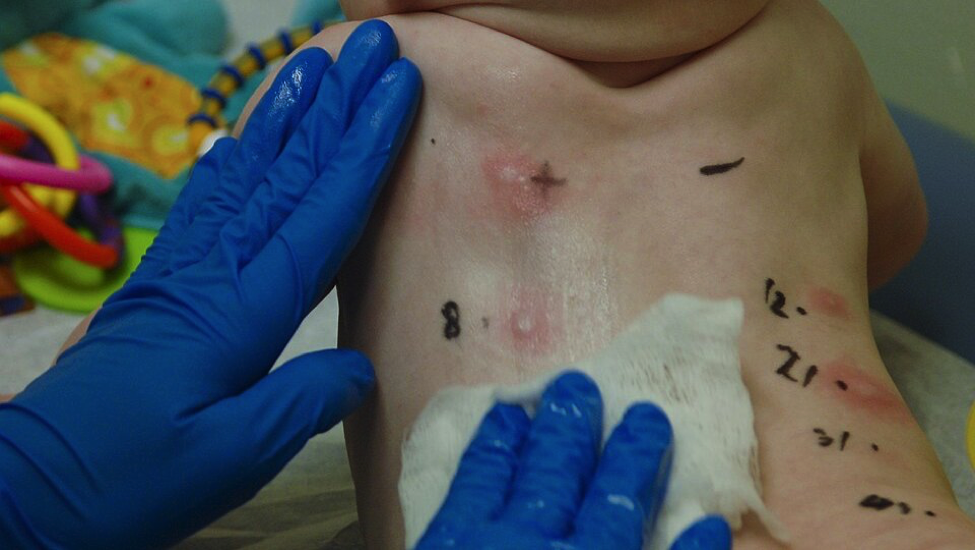
A clinician wipes allergens from a baby’s back after a skin prick test for common food allergens. Photo: U.S. Air Force, Airman 1st Class Austin Harvill (public domain).
The three-trigger test
Here is the filter. If any one of the three triggers below applies, ask your pediatrician for a referral. If none applies, primary care is usually the right place to keep managing symptoms.
Trigger one: a reaction that went beyond the skin. ACAAI lists the symptoms that call for epinephrine: shortness of breath, repetitive coughing, weak pulse, throat tightness, trouble breathing or swallowing, or symptoms in several body areas at once, such as hives together with vomiting or abdominal pain. Any episode that looked like that deserves a specialist’s review, even if it settled on its own. So does any reaction that ended with an emergency room visit or an epinephrine dose.
The reason is planning. After a food allergy diagnosis, ACAAI says the allergist should prescribe an epinephrine auto-injector, teach the family how to use it and hand over a written treatment plan. The organization also advises keeping two doses on hand, because a severe reaction can recur in about 20% of people. The child’s school needs its own emergency action plan. Those documents are easier to get right with a doctor who writes them routinely. Severe reactions to insect stings and medications fall in the same category: the AAP lists them next to food reactions among the problems these specialists treat.
Trigger two: a test result nobody can explain. Parents underestimate this one. ACAAI is blunt here: a positive test does not make a diagnosis on its own, testing should follow a history of reactions, and broad panels covering many foods should not be performed. Skin prick tests give results in about 20 minutes. Blood tests, which ACAAI calls a bit less exact, take about a week and come back as a number. Neither test shows whether a child will react to a real serving.
And when history and test results disagree, the usual answer is an oral food challenge. Under strict medical supervision, the child eats tiny amounts of the suspected trigger in increasing doses, then stays for a few hours of observation. ACAAI calls it the most accurate way to diagnose a food allergy, and for foods a child has never eaten but that are related to a known trigger, the best way to find out whether they are safe. The organization adds that it should only take place in an allergist’s office or a food challenge center with emergency medication and equipment ready. A child who passes can eat that item again. For a family, that changes grocery lists, school lunches and restaurant outings.
If your child’s diet was cut down on the strength of a panel alone, that is reason enough to book a visit.
Trigger three: a routine that stopped working. This trigger builds slowly. Chronic eczema that keeps flaring despite a solid skincare routine, hay fever or chronic sinusitis that disrupts sleep or school, and asthma that needs the rescue inhaler more often than the action plan allows all suggest that first-line treatment has reached its limit. For children whose asthma has an allergic component, some practices pair allergy testing with pediatric pulmonology so that triggers and lung function are assessed together. ACAAI adds a detail worth knowing: delayed reactions, appearing hours after a meal, are most typically seen in children whose eczema is a symptom of food allergy.
A specialist has more options at this stage. Allergy shots (immunotherapy) are one, for eligible children. Biologic medicines are another. In February 2024, the FDA approved Xolair (omalizumab) for IgE-mediated food allergy in adults and children 1 year or older, to reduce allergic reactions after accidental exposure, and patients who take it must keep avoiding their trigger foods. Treatments like these are prescribed and monitored in specialty care.
The immunology half of the specialty belongs here too. Frequent infections can point to an immune deficiency. The Jeffrey Modell Foundation’s warning signs of primary immunodeficiency include four or more new ear infections within one year, two or more serious sinus infections within one year and two or more pneumonias within one year. The AAP also lists frequent sinusitis, pneumonia or diarrhea, thrush and abscesses that keep coming back, and severe or unusual infections among the problems a pediatric allergist/immunologist evaluates. Testing for primary immunodeficiency and other immune system disorders is specialist work. According to the AAP, pediatric allergists/immunologists practice in children’s hospitals, university medical centers, large community hospitals and private offices, so a referral does not always mean a trip to a big academic division.
How to prepare for the first appointment
Once the referral is in place, preparation decides how useful that first hour will be. The more the specialist can learn from your notes, the less has to be repeated in the room. Write a timeline of each reaction: what your child ate or touched, how long before symptoms started, what they looked like and which treatment was given. Most reactions begin within two hours of eating, often within minutes, according to ACAAI, so timing is one of the first questions you will hear. Phone photos of hives or swelling help a lot, since rashes have usually faded by the day of the visit. Bring earlier test reports, a family health history of allergic conditions and asthma, and a list of current medicines, and call the office ahead of time to ask whether any medicine should be paused before skin testing. If your child already sees a pediatric pulmonology team for asthma, bring the latest lung function results and the current asthma action plan.
Check insurance early. Some health insurance plans, HMOs in particular, require a referral from the primary care doctor before a specialist visit is covered, and many limit coverage to in-network providers, so ask your insurance company for its list of in-network allergy providers before booking. It is also fair to ask how much experience the clinic has with your child’s specific condition, whether that is a food allergy, allergic asthma or a suspected immune deficiency, and whether its services include the tests your pediatrician mentioned.
But keep the pediatrician in the loop after the visit. The specialist sets the plan; the pediatrician sees your child far more often and will carry out most of it. To find a pediatric allergist, the AAP suggests asking your pediatrician or a local children’s hospital, or searching the directories run by ACAAI and the American Academy of Allergy, Asthma and Immunology (AAAAI).
Other Articles You May Find of Interest...
- When Should Your Child See a Pediatric Allergist? A Three-Trigger Test
- Candida sp. rRNA Results: What Molecular Testing Detects
- Ant Bites or Poison Ivy? How the Rashes Differ
- Can Stress Cause Cold Sores on the Lips?
- Gram-Positive Rods in a Blood Culture: Contamination or Infection?
- Can Head Lice Get Into Your Ears?
- Staph and Eczema: Why Infected Skin Needs Prompt Care