Your Health Magazine Contributor
4201 Northview Drive
Suite 102
Bowie, MD 20716
More Imaging Articles
What Is Teleradiology? How It Works and What Patients Should Know
Teleradiology is the practice of sending medical images, such as X-rays, CT scans, MRIs, and ultrasounds, to a radiologist in another location for interpretation.
If you have a scan overnight, on a weekend, or at a smaller community facility, a remote radiologist may read it.
The same kind of specialist reviews your images either way; only the reading location is different.
What teleradiology means in everyday care
Teleradiology moves the images, not the patient. Your scan takes place at your hospital or imaging center.
The radiologist who interprets it may be across town or in another state.
This differs from a telehealth video visit, where you talk with a clinician on screen.
With diagnostic imaging, you may not meet the radiologist, whether they work onsite or remotely. Their findings go into a written report.
RadiologyInfo.org, a patient information resource, explains that the report goes to the clinician who ordered your exam, who can discuss the results with you.
How teleradiology works, step by step
The path from scan to signed report is similar whether the radiologist works onsite or remotely:
- Imaging is performed. A technologist performs your X-ray, CT, MRI, or ultrasound at an imaging center or hospital.
- Images are stored and shared securely. The image files enter a medical image archive, often called a PACS, and become available to the remote radiologist through secure systems.
- The case is assigned. Software or a coordinator routes the exam to an appropriate radiologist, sometimes one who specializes in a particular body area or patient group.
- The radiologist interprets the images. They review the scan, compare it with prior studies when available, and prepare a report. Once finalized, the report is electronically signed.
- The report returns to your chart. It is sent to your ordering clinician and may also appear in your patient portal.
The report and the images are separate parts of your medical record. A report describes the findings; the image files let clinicians review the scan itself or compare it with later exams.
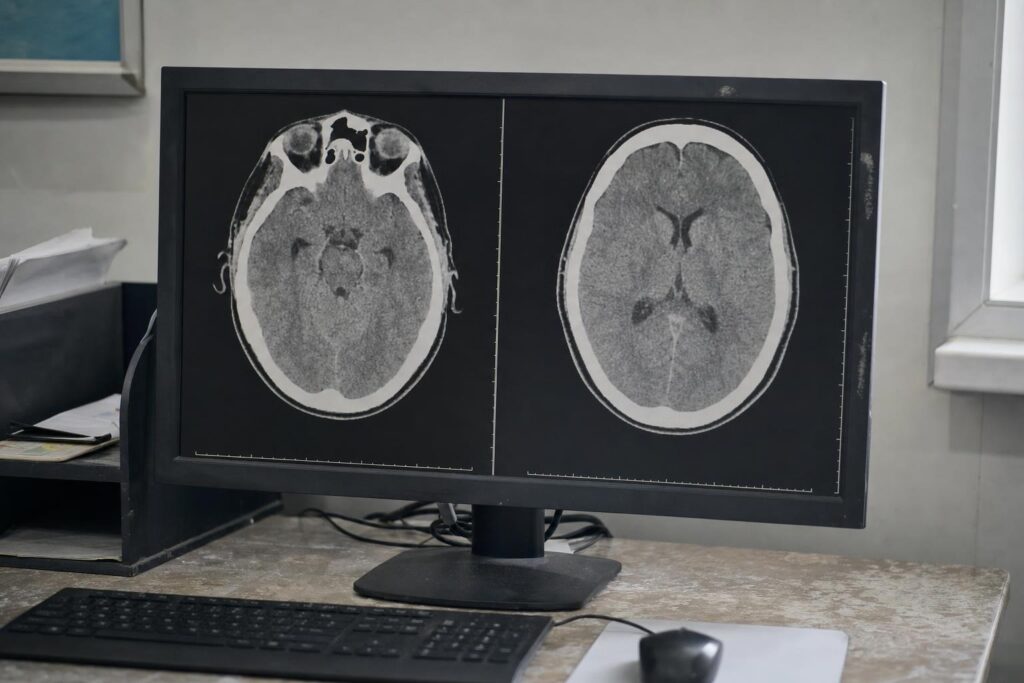
For clinicians: Pro Radiology’s guide to teleradiology explains typical reporting workflows, workstation setups, and support arrangements. The Pro Radiology guide focuses on radiologists’ working arrangements rather than patient guidance or U.S. regulation.
Who is reading my scan?
Radiologists are physicians with specialized training in interpreting medical images. Remote readers have the same professional role as onsite radiologists.
Hospitals check their qualifications and authorize them to provide specific services, a process known as credentialing and privileging.
Some health systems route certain exams to subspecialists, such as a pediatric radiologist for a child’s study or a neuroradiologist for a brain MRI.
Remote reading can make that possible without requiring the specialist to be in the building.
For radiologists considering remote reporting arrangements, what is teleradiology provides background on typical workflows, workstation setups, and support models.
Whoever reads your exam, their findings appear in the report. RadiologyInfo.org’s guide, “All About Your Radiology Report,” explains its typical sections and language, which can help you prepare for a conversation with your clinician.
Privacy and security basics
Because your images and report travel electronically, privacy questions are reasonable.
In U.S. care, remote reading does not remove an organization’s responsibilities to protect patient information.
The HIPAA Security Rule, administered by the U.S. Department of Health and Human Services, requires covered organizations to safeguard electronic protected health information.
This includes policies about who can access records, protection for equipment, and technical controls to prevent unauthorized access.
Hospitals also have oversight responsibilities for remote readers.
Under certain Medicare rules, a hospital may rely on a distant organization’s credentialing and privileging decisions, but conditions apply, including review of complaints and adverse events.
Remote radiologists must also meet applicable state licensing requirements.
Getting your results
When you receive your report depends on more than where the radiologist works.
Federal information-blocking rules under the 21st Century Cures Act aim to prevent unreasonable interference with access to electronic health information.
You may see a finalized report in your patient portal before your clinician has reviewed it.
Release timing can vary, so ask your imaging center when to expect the report and who will explain it.
A portal notification is not the same as a discussion of what the findings mean for your care.
A few habits can help:
- Read the “Impression” or summary section first. It usually contains the radiologist’s main conclusions.
- Expect technical language. A term on its own may not explain what a finding means for your health.
- Write down questions for your ordering clinician, who can interpret the findings alongside your symptoms and medical history.
Benefits you might notice
Remote reading does not guarantee faster or more accurate results. Its practical benefits depend on staffing, access to prior images, and communication between clinicians. It can support:
- After-hours coverage. A remote radiologist may be available when a local one is not, which can help with overnight emergency scans.
- Subspecialty access. A community imaging center can send a complex study to a specialist elsewhere.
- Care across locations. When facilities can share images, radiologists can review earlier scans without requiring patients to return to the original imaging site.
Coordination still matters. Your ordering clinician is usually your main contact for results, and it is reasonable to ask how urgent findings will reach them.
What to ask your imaging center or clinician
- Who will read my scan, and will it go to a subspecialist?
- How will my clinician and I be notified of an urgent finding?
- When should I expect the report in my portal?
- How do you protect my images and information during transfer?
- How can I share prior images so the radiologist can compare them?
- Whom should I contact with questions, or if I haven’t received my results?
Local context for Maryland, Virginia, and DC readers
Remote reading can connect community facilities with specialists elsewhere in the region, including access to radiology subspecialists when local staffing is limited.
UVA Health, for example, describes its teleradiology services as supporting patients and partner facilities.
Your own imaging center can explain whether it uses a similar arrangement and who provides the interpretation.
If you have had scans at different health systems, don’t assume the new facility can access them automatically.
Ask how to transfer prior images before your appointment. Your patient portal may show reports without providing access to the complete image files.
Bottom line
Teleradiology lets radiologists interpret images remotely and return a report to the team caring for you.
For patients, the key questions are when results will arrive, how urgent findings are communicated, and who will explain the report.
For clinicians exploring the working arrangements behind remote reading, the Pro Radiology guide offers an overview of workflows and support.
Other Articles You May Find of Interest...
- What Is Teleradiology? How It Works and What Patients Should Know
- Radiology Clinics in Southern Sydney: Options to Consider
- What Can Different Types of CT Scans Detect? A Patient Guide
- A Hypoechoic Renal Mass on Ultrasound: Next Steps
- Elastography: The Scan Replacing Some Liver Biopsies
- ‘No Suspicious Osseous Lesion’: Good News, Explained
- A Normal Pituitary MRI: What the Radiologist Saw