






Your Health Magazine Contributor
4201 Northview Drive
Suite 102
Bowie, MD 20716
More Health Technology Articles
How Profile Photos Can Connect Health-Related Digital Identities Across Platforms
A profile photo can be more than a picture attached to an account. The same photograph may appear across platforms, including professional, social, and health-related profiles.
A healthcare professional might reuse the same headshot on a practice website, LinkedIn, Instagram, or another public account, while a patient may use the same image across support communities and social platforms. Reverse-image and face-based search provide another starting point for understanding those connections, but a similar face does not confirm an account or identity.
At a Glance
| Question | What matters most |
| Can one photo appear on several platforms? | Yes, when users reuse images |
| What makes a searchable photo useful? | Clear details, lighting, resolution, limited obstruction |
| Does every visual match represent the same person? | No. Similar faces can mislead |
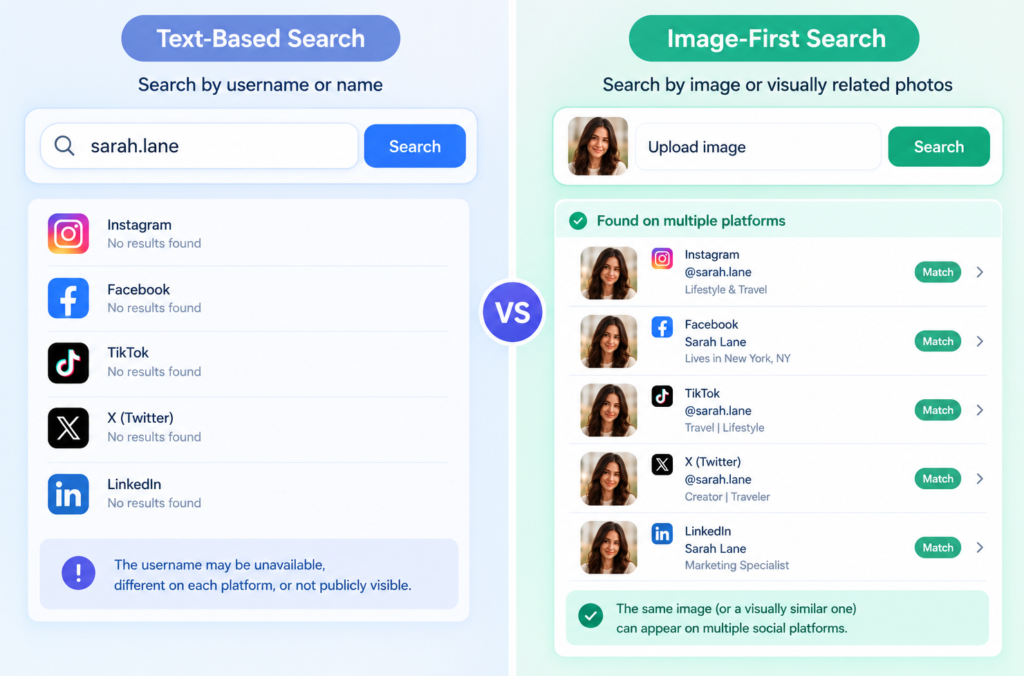
| Can usernames find every account? | No. Usernames may differ or change |
| Is a profile-photo search definitive? | No. Results require verification |
Why One Photo Can Lead to Several Profiles
People often think a profile picture belongs to one account, but photographs travel.
Related photographs can provide clues when text searches fail. Visual search offers another route, but does not prove ownership.
For example, one profile may use a close-up portrait, another the same portrait with a different crop, and a third a photograph from the same session.
What Happens During an Image Search?
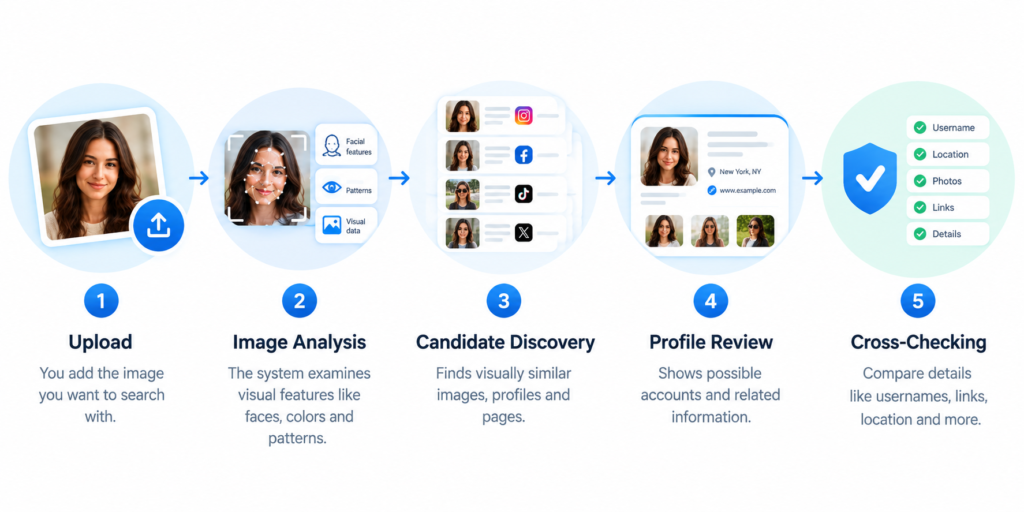
A user supplies an image, and the search system examines visual characteristics. It may look for similar images, matching faces, related pages, or public profiles.The process is:
Upload → Image Analysis → Candidate Discovery → Profile Review → Cross-Checking
A result is a candidate, not a confirmed identity. Details provide context.
What Makes a Photo More Searchable?
A clear portrait generally provides more information than an obstructed photograph.
| Image characteristic | Potential effect |
| Clear facial details | More visual information |
| Good lighting | Easier feature recognition |
| Front-facing pose | More recognizable details |
| Higher resolution | Preserves detail |
| Minimal obstruction | Less missing information |
| Heavy filters | Harder comparison |
| Extreme cropping | May remove context |
| Group photographs | Multiple faces complicate results |
No image guarantees a result.
The Role of Profile-Photo Reuse
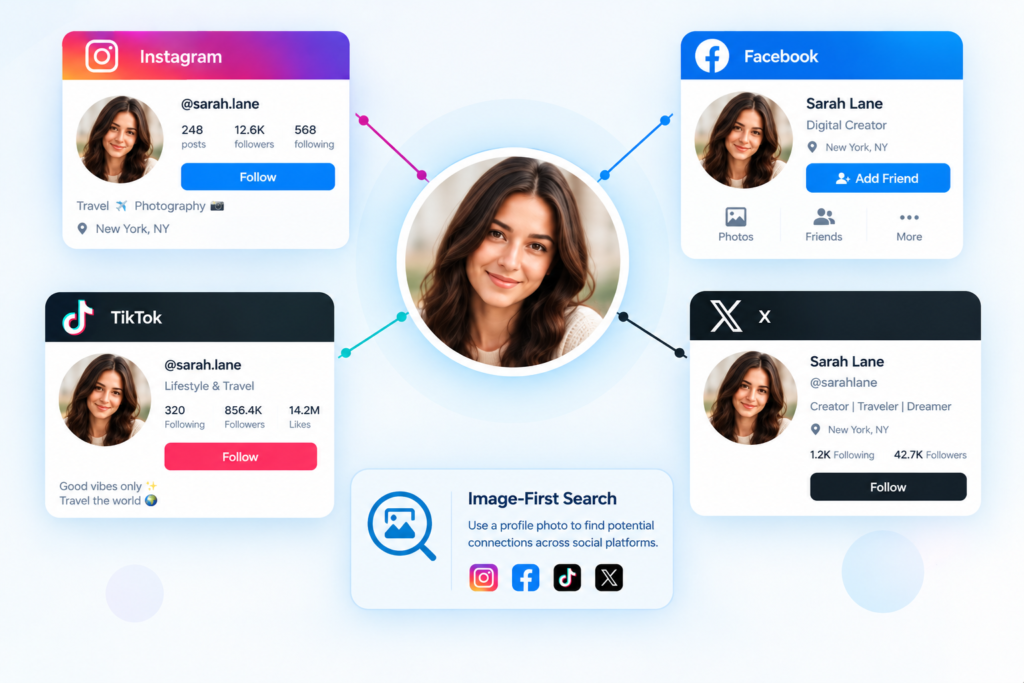
Image reuse connects digital identities. A person may create a portrait for an event, use it on one account, and later upload it elsewhere. The photograph becomes a bridge.
| Platform | Possible image relationship |
| Professional profile | Original headshot |
| Square crop | |
| Original or edited version | |
| X | Smaller version |
| Community profile | Older copy |
Different usernames may lead to related photographs.
When a Visual Match Is Not Enough
A face can resemble another face without representing the same individual. Search results can also contain unrelated images.
| Result type | Meaning |
| Visual similarity | Image resembles the source |
| Possible identity connection | Several details suggest a relationship |
| Strongly corroborated match | Multiple public details agree |
Visual similarity is only the first level. Shared public details provide stronger context.
Why Cross-Platform Searching Can Matter in Healthcare
Healthcare professionals increasingly maintain public profiles across practice websites, professional directories, LinkedIn, Instagram, and other platforms. Patients may also participate in public wellness communities or support groups under different usernames. Because usernames can vary, a profile photo may sometimes provide another way to locate related public accounts. Face2Social lets users explore whether publicly available social media accounts may be connected by a photograph.
Profile Photos Change Over Time
Digital identities change. Old photographs can remain public after profile pictures change. Related photographs may provide context.
What Can Make Results Difficult?
| Challenge | Why it matters |
| Private profiles | Information may be inaccessible |
| Deleted accounts | Older pages may disappear |
| Changed profile pictures | The image may no longer be active |
| Low-quality photographs | Details may be missing |
| Filters and edits | Appearance can change |
| Different appearances | Styling can affect similarity |
| Duplicate images | Photos may appear on unrelated pages |
| Limited indexing | Not every profile is searchable |
| Similar-looking people | A match can still be incorrect |
These limitations make image search a discovery method rather than automatic identity confirmation.
A Better Way to Read Search Results
The number of results is not the key measurement. A smaller set may be more useful.
| Search outcome | What it may tell you |
| Many unrelated images | Broad similarity |
| Several copies of one photograph | Image reuse |
| Similar portraits across platforms | Possible connection |
| Direct profile pages | Useful for discovery |
| Consistent public information | Stronger context |
| Conflicting information | Needs investigation |
Relevance matters more than quantity.
Why Different Platforms Produce Different Results
Search services differ in coverage.
| Factor | Possible difference |
| Index coverage | One service may contain a page another does not |
| Platform focus | Services emphasize different profiles |
| Image matching | Systems use different visual signals |
| Profile availability | Public and private accounts differ |
| Search timing | Pages and indexes change |
A missing result does not prove absence.
Understanding False Matches
False matches can happen when people look alike or photographs are reused.
The distinction is between “this image appears here” and “this account belongs to this person.”
Privacy Matters in Health-Related Searches
Public information should be handled responsibly, especially when health, medical treatment, mental health, or other sensitive topics may be involved. A public profile photo should not be treated as permission to investigate or expose private medical information. Search tools should not bypass privacy settings, reveal protected information, or be used to harass patients, providers, or other individuals.
Where Face-Based Social Search Fits
Image-first search may have a limited role when someone is trying to verify a public-facing professional identity or determine whether the same public profile image appears across multiple accounts. If an exact name, practice website, or professional directory listing is available, those sources may be more direct.
Face2Social uses a profile image as an initial search signal and visual discovery layer, but any result should be treated as a lead rather than proof of identity.
A Simple Search Workflow
Step 1: Choose the clearest image.
Step 2: Examine context.
Step 3: Run the visual search.
Step 4: Separate direct matches from similarities.
Step 5: Compare context.
Step 6: Stop when evidence is insufficient.
What Users Should Not Assume
“The face looks similar, so it must be the same person.” Not necessarily. Facial similarity is only one clue.
“The search found nothing, so there is no account.” Not necessarily. The profile may be private, deleted, or outside coverage.
“The first result must be correct.” Search rankings are not proof.
Frequently Asked Questions
Can a profile photo be used to find social accounts?
Sometimes, depending on the image and coverage.
Does the same photo always mean the same person?
No. Photos can be copied or reposted.
Is a clear photograph better for searching?
Generally, yes, but it does not guarantee a match.
Why do different search services show different results?
They use different indexes, coverage, and rankings.
Can an old profile photo still be useful?
Potentially. Older photos may remain public.
Should results be treated as proof of identity?
No. Visual matches are leads requiring context.
The Bigger Picture
Profile photographs form an informal layer of digital identity, including for healthcare professionals, wellness businesses, patients, and people participating in public health communities. The same visual identity may follow someone across multiple platforms.
Visual search does not replace professional directories, practice websites, names, usernames, or direct links. It provides another route for discovering public information and should be used cautiously when health-related identities or sensitive information may be involved.
Final Thoughts
Profile photos can connect different parts of a person’s public online presence, including professional and health-related profiles, but discovery and verification are different things. When using face2social, treat visual results as a starting point, compare them with reliable public information, recognize the limits of facial matching, and respect medical and personal privacy.
Other Articles You May Find of Interest...
- Why Documentation Matters in Complex Product Development
- How Profile Photos Can Connect Health-Related Digital Identities Across Platforms
- Smart Home Health Devices: Are Your Network Details Leaking Confidential Data?
- 12 Healthcare App Development Companies in 2026 – 2027
- 10 Healthcare IT Consulting Companies for Digital Transformation in 2027
- The Laboratory of the Future: Automation, AI and Smarter Scientific Research
- Hyperbaric Oxygen Therapy and Recovery: What Consumers Should Know About HBOT





