






More Press Releases Articles
From Turkish Delight to Turkish Hairlines: A Story of How Turkey Became the Top Hair Transplant Destination
The following content consists of press releases and company announcements submitted by third parties. These articles are provided for informational purposes and have not been independently verified by Your Health Magazine.
How the World Learned to Think Differently About Turkey
For most of the twentieth century, Turkey existed in the Western imagination as something vaguely exotic and not entirely trustworthy. A land of bazaars, desert heat, and Byzantine intrigue. Then came a scene from a children’s fantasy novel, a boy, a witch, and a box of enchanted sweets, and suddenly the whole world knew one thing about Turkey: the Turkish delight. The Chronicles of Narnia did what decades of tourism campaigns could not. Turkish Delight became a cultural shorthand for the country itself.
That association held for a surprisingly long time. But over the past decade, a new shorthand has quietly taken over. Today, Turkey is no longer best known for its confectionery. It is known for its surgeons.
Every year, hundreds of thousands of patients fly to Turkey for hair transplants, dental work, and cosmetic procedures. The volume is staggering enough that Turkish flights have earned the nickname Turkish Hairlines. But the question worth asking is not just how many people are coming. It is why. And the answer is more interesting than most people expect.
Why Do Hundreds of Thousands of Patients Travel to Turkey for Medical Procedures Every Year?
The easy answer is price. And yes, procedures in Turkey cost a fraction of what they cost in the United States, the United Kingdom, or Western Europe. But price alone does not explain why patients keep coming back, why word-of-mouth has been so overwhelmingly positive, or why Turkish clinics keep collecting international medical awards. Price gets you on the plane. Quality is what makes you tell everyone you know.
What Turkey has built over the past two decades is a genuinely world-class healthcare infrastructure, not as a side effect of medical tourism, but as a deliberate national policy. Patients receiving treatment in Turkey are treated in internationally accredited hospitals and clinics, operating under strict Ministry of Health oversight. The facilities are modern and meticulously clean. The medical staff are attentive in a way that patients from overburdened Western healthcare systems often find striking. And the entire experience, from consultation to aftercare, is designed around the international patient in a way that most domestic healthcare systems simply are not.
Turkey is not a budget destination that happens to have surgeons. It is a medical destination that happens to be affordable.
How Did Turkey Become the World’s Hair Transplant Capital?
Hair restoration surgery did not begin in Turkey, but Turkey is where it grew up.
The earliest hair transplant procedures used a technique called FUT (Follicular Unit Transplantation) which involved removing a strip of scalp tissue and was, by any measure, a real surgical operation. Recovery was significant, scarring was permanent, and the barrier to entry for patients was high. The field was relatively niche.
Then came FUE (Follicular Unit Extraction) a method that harvests individual follicles rather than strips of tissue, dramatically reducing recovery time and visible scarring. DHI (Direct Hair Implantation) followed, refining the implantation step further. As these techniques made procedures more accessible, patient numbers grew. And as patient numbers grew in Turkey, something remarkable happened: the entire ecosystem accelerated.
A hair transplant surgeon in the United States or Germany might perform two to four procedures in a month. In a leading Turkish clinic, that same surgeon operates on two patients a day. The cumulative effect of that volume on skill, precision, and outcome predictability is difficult to overstate. Surgeons develop an intuitive mastery that simply cannot be replicated at lower frequencies. Medical technicians, who play a critical role in graft extraction and handling, develop the same. The entire team becomes, through sheer repetition, better.
What Hair Transplant Technologies Have Turkish Clinics Pioneered?
When FUE first emerged, the standard instrument used to create recipient channels in the scalp was a steel blade. It was functional, but blunt in its limitations. The incisions it created were imprecise, and the trauma to surrounding tissue was greater than it needed to be.
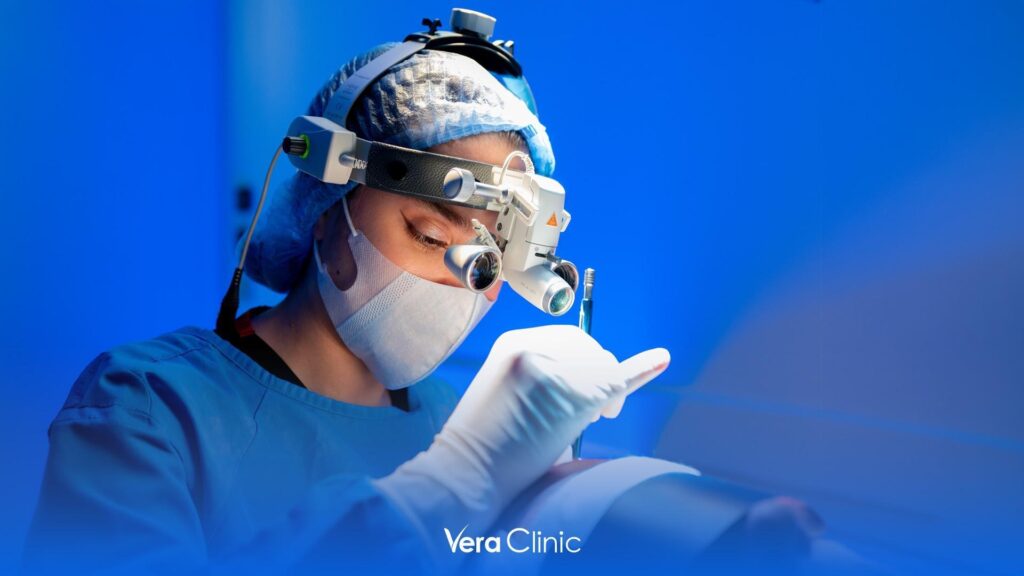
Istanbul’s Vera Clinic changed that. Their surgeons pioneered the Sapphire FUE method, replacing the steel blade with a tip made from natural sapphire crystal. The result was sharper, more precise incisions, reduced tissue trauma, faster healing, and denser, more natural-looking results. What began as an innovation at one clinic gradually became the industry standard. This is how progress works in a competitive, high-volume market: one team solves a problem well, and the field follows.
Vera Clinic’s most recent contribution is even more ambitious. In collaboration with Appsilon Enterprise (a materials engineering firm with roots in aerospace manufacturing, for whom this represented an entirely new application of their expertise) the clinic developed the Vector-10™, a surgical tool with a tip made from CVD lab-grown diamond. The research and development behind it was conducted through Vera Academy, the clinic’s own medical education and research arm, which began by training Turkish physicians in facial cosmetic surgery and has since expanded its scope to the full range of hair restoration techniques.
Lab-grown diamond is harder, smoother, and more precisely manufacturable than any natural stone. In a surgical instrument used to make thousands of micro-incisions per procedure, those properties matter enormously. The Vector-10™ is not a marketing exercise. It is the product of a genuine research partnership between a medical team and an engineering team, solving a real problem in a field where precision determines outcomes.
What Separates the Best Value FUE Hair Transplant Clinics in Turkey from the Rest?
Vera Clinic has received the European Award in Medicine as the best hair transplant clinic in Turkey in the hair transplant surgery category. It has won the iF Design Award for its clinic architecture. It has received the WhatClinic Patient Satisfaction Award.
These are not the same awards given to everyone who enters. They are competitive, internationally judged recognitions that reflect a consistent standard of care sustained over years.
Why Is Turkey Now Synonymous With Hair Restoration Tourism?
Turkey’s story is one of deliberate reinvention. A country that spent decades shaking off misrepresentations built something real: a healthcare system that treats international patients with a standard of care that their home countries charge multiples more to provide, and often still fall short of delivering.
The Turkish delight that Edmund Pevensie ate in a snowy Narnian forest gave Turkey a charming association that lasted for generations. What Turkey has built in medicine will last considerably longer, and the results are far more than enchanting.
Media Contact
Email: [email protected]
Organization: Vera Clinic
Website: https://www.veraclinic.net/
Other Articles You May Find of Interest...
- Inside Cronos Dental Clinic: How Advanced Dentistry in Albania Is Evolving for International Patients
- How MedXpert Supports Medical Credentialing in the USA
- Glow Beyond the Surface: Discover the Power of IPL at Facial Mania Med Spa
- AN EASY PILL TO SWALLOW
- Dr Michel Alkhalil on Multi-Specialty Respiratory Care in Oakland County
- Shared Practices Group Announces Strategic Minority Investment from M-One Capital
- Biohackers World Conference & Expo 2026 to Showcase Next-Generation Longevity and Human Optimization in Chicago





