






More Practice Management Articles
How Administrative Burnout Is Affecting Healthcare Providers in 2026
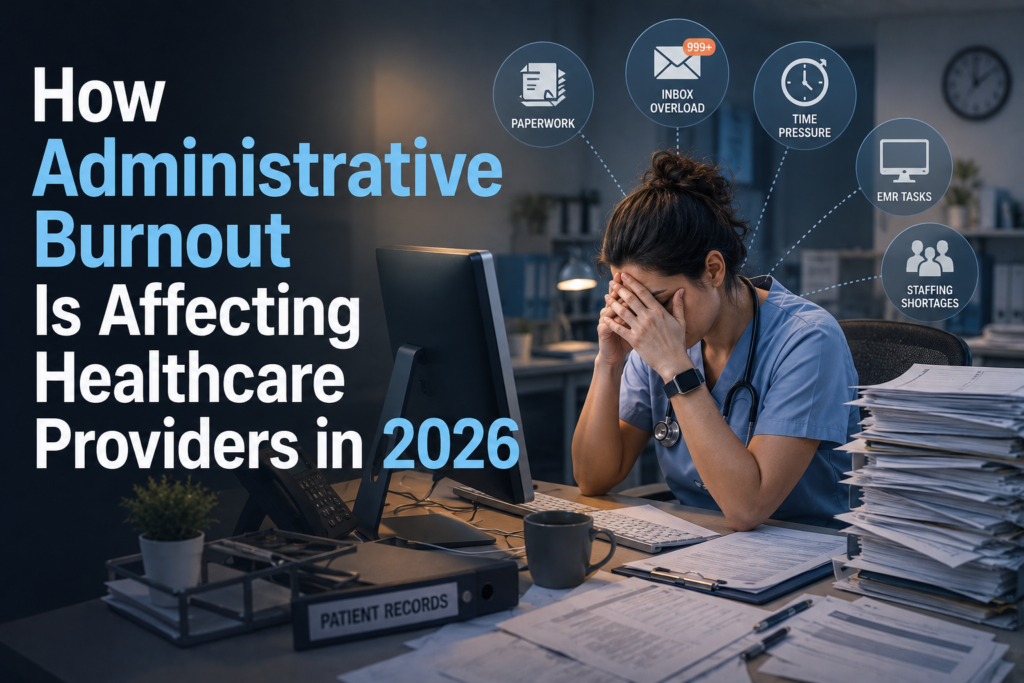
The crisis happening quietly behind the walls of hospitals, clinics, and even individual practitioners’ offices around the nation does not have anything to do with a virus or a lack of medical expertise. It has to do with paperwork.
Ask just about any doctor, nurse, or advanced practice provider, and you’ll get the same answer. They got into medicine to help others. They spent years training, sacrificing sleep, relationships, and free time, simply because they were passionate about what they did. And now? They spend more time looking at screens than their patients.
This is called administrative burnout. And in 2026, it’s one of the biggest problems in the American healthcare industry.
What Is Administrative Burnout and Why Is It Different?
Burnout in healthcare isn’t new. The emotional weight of caring for sick patients, losing people despite your best efforts, and working exhausting shifts has always taken a toll. But administrative burnout is a specific and particularly corrosive strain. It’s the exhaustion that comes not from doing your job but from being prevented from doing it.
When a physician spends nearly as much time charting notes in an electronic health record as they spend with actual patients, something is deeply broken. According to recent research, for every 15 minutes a physician spends with patients, they spend an average of nine minutes charting notes in their EHR software. Across a full workweek, that adds up fast. This is why many practices are now turning to professional medical billing services to offload the administrative weight and let clinicians focus on what they do best.
The numbers tell a sobering story. In 2025, Medscape’s Physician Burnout and Depression Report revealed that 62% of physicians reported burnout, with too much bureaucratic work and electronic health records consistently ranking as the top two contributors.The problem cuts across every specialty from primary care to behavioral health billing where providers are drowning in documentation demands that have nothing to do with actual patient care.
The Paper Mountain: Prior Authorization’s Crushing Weight
If documentation is the slow drip that exhausts clinicians, prior authorization is the flood.
Prior authorization, the process by which physicians must get insurance company approval before a patient can receive a medication, procedure, or specialist referral, has become one of the most despised features of modern medical practice. And for good reason.
Physicians complete an average of 40 prior authorizations per week, and nearly one in three (32%) report that requests are often or always denied. More than nine in 10 physicians (94%) say prior authorization contributes to burnout. Prior authorization consumes an average of 13 hours of physician and staff time each week.
Let that sink in. A bureaucratic process designed by insurers to manage costs is, in practice, harming patients and burning out the people who care for them.
The burden is staggering. On average, physicians complete 43 prior authorizations per week, dedicating over 16 hours filling out forms, waiting on hold, and appealing denials. These hours do not come from spare time; they detract from patient care. The delays are not just inefficient, they’re dangerous. There are documented cases of a child with new-onset Type 1 diabetes stuck in the hospital while awaiting approval for generic insulin, and a critically ill infant in respiratory distress denied admission. These represent what happens when administrative machinery overrides clinical judgment.
The EHR Trap: When Technology Becomes a Burden
EHRs were expected to enhance efficiency in the practice of medicine. The picture was promising seamless information exchange, reduced errors in medicine, enhanced care coordination. The real situation has turned out to be rather messy.
Doctors spend 2 hours doing EHR-related activities for each hour they spend taking care of their patients. According to statistics provided by the American Medical Association, doctors have an average workweek of 57.8 hours, during which they spend 27.2 hours caring for patients directly, 13 hours caring for patients indirectly (order entry, documentation, interpreting test results) and 7.3 hours doing administrative work (prior authorizations, insurance forms filling).
Thus, only about half of their work is devoted to treating patients.
Documentation affects patient care by reducing eye contact between doctors and their patients, increasing the probability of mistakes and creating administrative barriers. As doctors spend the majority of their time looking into computers, eye contact is lost and discussions become hurried. One of the most powerful tools used by doctors, the therapeutic relationship is undermined by excessive documentation.
Who Is Most at Risk in 2026?
Burnout does not distinguish based on specialty, but some providers are feeling more pressure than others.
Advanced Practice Providers (APPs) in general, especially APPs in primary care settings, have reported higher levels of burnout symptoms, administrative burden, and plans to reduce their work as clinicians that should be considered during discussions of workforce planning. This indicates that system-level challenges faced by clinicians continue regardless of provider type.
Specialties dealing with behavioral and mental health services experienced high levels of increase in burnout rates due to the pandemic and continuous shortage of resources, resulting in elevated risk for providers. Rehabilitation specialists and allied health workers have been experiencing higher workloads and role expansions without any decrease in pace.
Healthcare workers in the U.S. are entering 2026 facing growing pressure; nearly half of the healthcare workers have indicated that they do not find their jobs sustainable anymore. As one clinician said: I express to my boss all the time that I’m tired. I don’t want to quit and leave my clients, but I just got off of a leave of absence to come back to the same thing.
The Downstream Cost: Patients, Workforce Stability, and Healthcare’s Future
Administrative burnout isn’t just a personal problem for the providers experiencing it. It’s a systemic crisis with consequences that reach every patient.
Nearly one in four physicians said they are planning to leave clinical medicine within the next few years because of administrative burden. Every physician who leaves takes with them years of training, institutional knowledge, and established patient relationships that cannot be easily replaced.
High burnout correlates with higher turnover, reduced clinical capacity, increased safety risks, and lower engagement. Addressing it requires systemic, organization-level solutions aligned with staffing models, operating budgets, and patient care goals.
The Dr. The Lorna Breen Health Care Provider Protection Act allocated $103 million toward healthcare worker mental health an acknowledgment, at the federal level, that this crisis demands a real response.
What’s Actually Changing and What Needs To
There are genuine reasons for cautious optimism in 2026, even as the crisis persists.
On the regulatory front, as of January 1, 2026, impacted payers across Medicare Advantage, Medicaid, and Marketplace plans are required to send prior authorization decisions within 72 hours for expedited requests and 7 calendar days for standard requests. Payers must now also explain denials and publish aggregate approval data publicly changes with real potential to reduce the weeks-long limbo that has caused so much patient harm.
Technology is also beginning to offer meaningful relief. Ambient documentation systems capture patient visits in real time and generate structured draft notes, reducing manual data entry and after-hours charting. Mount Sinai Health System has rolled out Microsoft Dragon Copilot to streamline documentation and automate administrative tasks for select care teams, with plans to expand system-wide in 2026.
Health systems are piloting AI agents that read the chart, pull required documentation, and submit electronic prior authorizations without human keystrokes. The Medical University of South Carolina says the technology reclaimed more than 5,000 staff hours each month, while early adopters report first-pass approval rates topping 95%.
Across the industry, 45% of health systems are now using AI to automate documentation to lower burnout. Organizations with Chief Wellness Officers have 10% lower burnout rates, and team-based care models reduce primary care burnout by 23%.
But tools and policies alone won’t solve a problem that is, at its root, structural. Physicians need meaningful autonomy over their clinical work. They need administrative systems that serve care delivery rather than obstruct it. And they need insurers that treat prior authorization as a genuine safety measure not a financial gatekeeping exercise dressed up in medical language.
What Providers Can Do Right Now
While systemic reform takes time, providers and practices aren’t entirely without agency.
Mandated protected time for administrative tasks reduces burnout by 20%. Clinicians with high workplace social support have 40% fewer burnout symptoms. These aren’t small numbers.
At the practice level, delegating prior authorization tasks to dedicated staff, adopting ambient documentation tools, and advocating within professional associations for policy reform are all meaningful steps. At the individual level, recognizing administrative burnout as a legitimate occupational injury not a personal failure is the essential first step.
Notably, only 13% of burned-out physicians sought professional help in the last year. That number needs to change.
Final Thought
Health care has always been difficult. Nobody entering the profession ever expected anything else. However, there is a difference between difficult because of the complexities of working with human beings versus difficult because of being overwhelmed by the processes that have never been built around the needs of either the clinician or the patient.
In 2026, the administrative burden in health care has reached a crisis point. People are noticing it. However, just noticing something does not solve it. Solving it requires action: better technology, more sensible insurance, more regulation, and a fundamental change in the culture of respect around the time of those we trust with our lives.
Healthcare providers didn’t sign up to become professional form-fillers. It’s time to let them be what they trained to be.
Other Articles You May Find of Interest...
- How Dental Practices Can Evaluate IT Support Providers in 2026
- Sunday Night Report: Why So Many Psychologists Work the Weekend and How to Stop
- How Healthcare Professionals Can Identify Signs of Exploitation
- Why Reputation Management Has Become a Priority for Health Websites
- Why Most Healthcare Strategies Fail During Execution
- 5 Reasons Medical Office Cleaning Should Never Be Overlooked
- Build the Right ASC the First Time: A Step-by-Step Plan From Idea to First Case




