






Your Health Magazine
4201 Northview Drive
Suite #102
Bowie, MD 20716
301-805-6805
More Health News & Research Articles
Best Practices for Choosing USA Made Research Peptides
When it comes to sourcing research peptides, origin matters more than many procurement teams initially realize. The country where a compound is synthesized affects the regulatory environment the manufacturer operates in, the consistency of quality controls applied during production, and the accountability that exists if something goes wrong. For laboratories that prioritize research integrity, understanding how to choose domestic peptides well is a worthwhile investment of time.
Why Domestic Sourcing Deserves Serious Consideration
Regulatory Oversight Creates Accountability
Peptide manufacturers operating within the United States are subject to oversight that does not apply equally to producers in regions with looser standards. This does not automatically make every domestic supplier excellent, but it does mean there is an accountability framework in place that provides researchers with meaningful recourse if quality standards are not met.
Suppliers based in the US are also more accessible when questions or issues arise. Communication across time zones is simpler, shipping logistics are more predictable, and the legal frameworks governing commercial transactions are more familiar to domestic research institutions.
Consistency in Production Standards
Established domestic manufacturers tend to operate with documented production protocols that are applied consistently across batches. This consistency is what research teams depend on when they need their compounds to behave the same way in experiment three as they did in experiment one.
Batch-to-batch variation is one of the most frustrating sources of unexplained variability in research data, and it is disproportionately common with suppliers who do not maintain rigorous production discipline.
What to Look for When Evaluating Domestic Suppliers
Independent Third-Party Certificates of Analysis
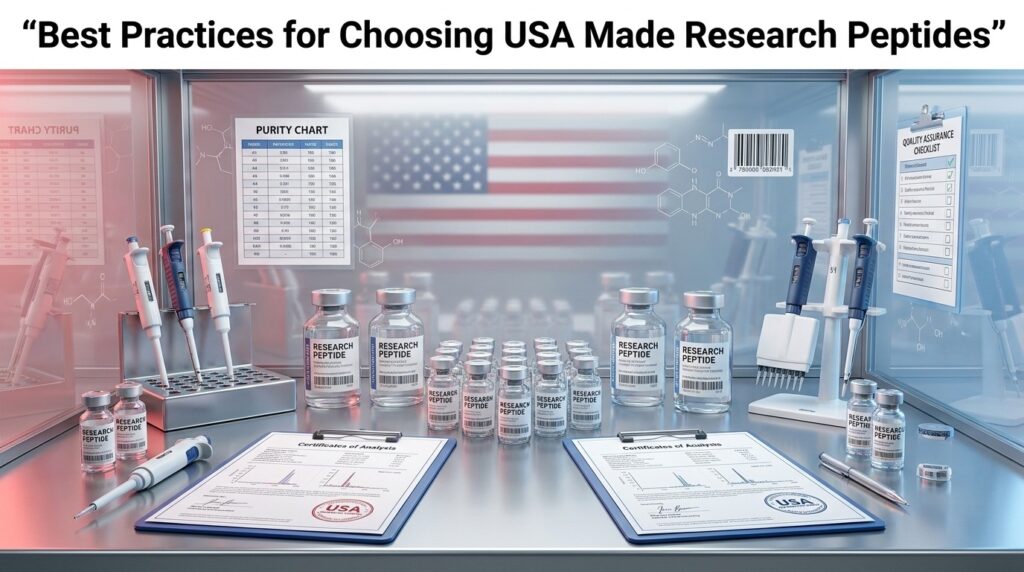
A certificate of analysis from an accredited, independent laboratory is non-negotiable. This document should be batch-specific, include the results of HPLC purity analysis and mass spectrometry identity confirmation, and clearly state the name of the testing laboratory along with the testing date.
Domestic suppliers who take quality seriously will make these certificates easy to access before purchase. Those who do not provide them readily, or who offer only in-house testing results, are not meeting the standard serious research requires.
Research teams building their domestic supply chain often use well-documented platforms as reference points. USA Made Peptides from suppliers who publish independent testing data give laboratories a practical starting point for evaluating what domestic sourcing looks like at a high standard.
Transparent Manufacturing Information
A reputable domestic supplier should be able to describe where their compounds are synthesized, what production protocols are followed, and how finished products are stored before shipping. Facilities that follow established quality frameworks tend to produce more consistent compounds than those without documented procedures.
Ask these questions before placing a first order. The quality of the answers tells you a great deal about the organization behind the products.
Proper Packaging and Cold-Chain Compliance
Domestic sourcing reduces transit time, which helps preserve compound integrity during shipping. But packaging still matters. Lyophilized peptides should arrive in sealed vials with appropriate labeling that includes the compound name, batch number, mass, purity, storage requirements, and expiration information.
Cold-chain handling for temperature-sensitive compounds should be confirmed with the supplier before ordering. Even short transit times can cause degradation if temperature controls are not maintained throughout the journey.
Practical Tips for New Procurement Teams
Start with a Small Test Order
Before committing significant budget to a new supplier, place a smaller initial order to evaluate the actual experience. Review the documentation carefully when it arrives, inspect the packaging and physical condition of the compounds, and assess how well the supplier communicated throughout the process.
A single well-evaluated test order tells you far more than any amount of pre-purchase research.
Cross-Check the Certificate Results
For critical compounds, consider having the batch independently verified by a third laboratory of your choosing. This additional step is particularly valuable when establishing a new supplier relationship or when working with a compound that will be used across a long-running study.
Document Your Sourcing Decisions
Keep records of every supplier evaluation, including the criteria you assessed, the documentation you reviewed, and the results of any in-house verification. This record supports institutional compliance requirements and makes future procurement decisions faster and more consistent.
Laboratories looking to standardize their approach to domestic peptide sourcing often reference catalogues like USA Made Peptides to understand what well-documented, domestically produced options look like across a range of compound types.
The Takeaway
Choosing research peptides made in the United States is not just a preference for some teams. It is a deliberate quality and accountability decision. The regulatory environment, production standards, and supplier accessibility that come with domestic sourcing provide a foundation that supports more reliable and reproducible research.
Apply the same evaluation rigor to every supplier, document your decisions carefully, and let quality evidence guide your choices rather than price or convenience alone.
Disclaimer: All peptides referenced in this article are intended strictly for laboratory and scientific research purposes only. They are not intended for human or animal consumption, medical treatment, or any therapeutic application. Researchers must follow all applicable institutional protocols and regulatory requirements when sourcing and handling research compounds.
Other Articles You May Find of Interest...
- Best Practices for Choosing USA Made Research Peptides
- How Scientists Evaluate a Reliable Source for Research Peptides
- Best Nootropics for Studying in 2026: Where Avantera Elevate Fits
- Orbital vs Reciprocal Shakers: Which Is Best for Your Lab Needs?
- Peptide Sources: Third Party Tested Peptides for Research and Supplement Use
- Latest Insights on Peptide Regulation and Its Impact on Health
- Evaluating Peptide Suppliers: Purity, Testing Methods, and Quality Control




