






More Gastroenterology Articles
Peptides for Gut Health: What the Research Currently Shows
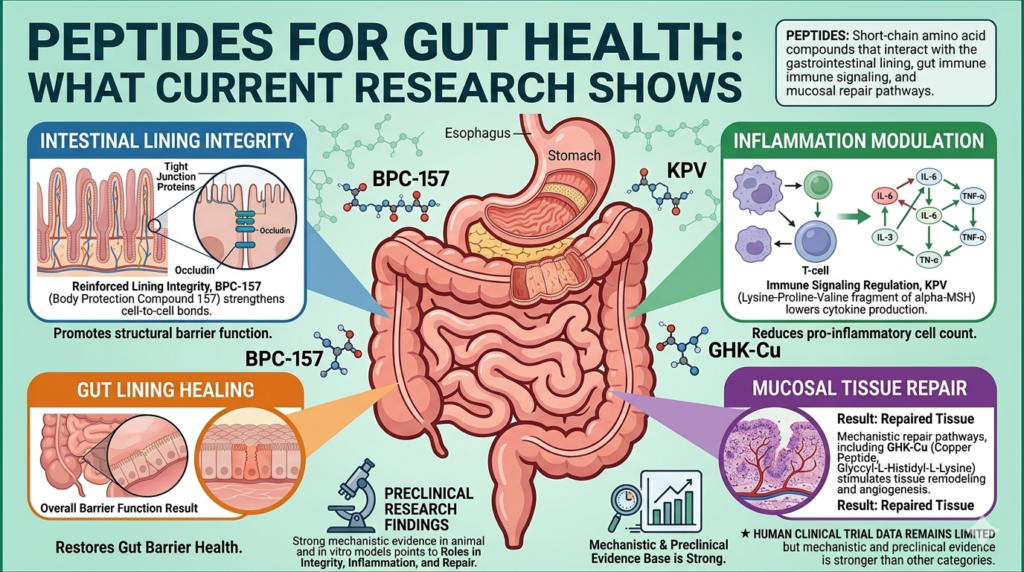
Peptides studied in gut health research are short-chain amino acid compounds that interact with the gastrointestinal lining, gut immune signaling, and mucosal repair pathways. The most researched in this context are BPC-157, KPV, and GHK-Cu. Preclinical data across animal and in vitro models consistently points to roles in intestinal lining integrity, inflammation modulation, and mucosal tissue repair. Human clinical trial data remains limited, but the mechanistic and preclinical evidence base is stronger for gut-related peptides than for most other peptide research categories.
Which Peptides Are Best for Gut Healing?
What does BPC-157 do to the gut?
BPC-157 (Body Protection Compound-157) is a 15-amino acid peptide derived from a protein found in gastric juice. It is among the most studied peptides in gastrointestinal research. In preclinical models, BPC-157 has demonstrated the ability to accelerate healing of the intestinal lining, support mucosal tissue repair, and promote angiogenesis, the formation of new blood vessels that supply healing tissue. Studies in animal models show consistent effects on gut wall integrity, including reduction of intestinal permeability markers associated with leaky gut. Because BPC-157 was originally derived from gastric juice, oral delivery remains an active area of research, and oral BPC products are among the formulations being explored for potential gut-targeted applications alongside injectable formulations. Experimental validity in this area depends heavily on compound quality. Contaminants in BPC-157 samples directly skew mucosal repair data, which is why researchers rely on high purity peptides for research with independently verified third-party COAs.
Does BPC-157 work immediately in research models?
In animal studies, BPC-157 shows relatively rapid effects on tissue repair markers compared to untreated controls, with measurable changes observed within days in acute injury models. However, “immediately” is context-dependent. Healing cascade activation may begin quickly, but measurable structural repair in intestinal lining models takes longer. There is no human clinical data establishing a timeline for gut-specific effects.
What is KPV and how does it relate to gut health?
KPV is a tripeptide (Lys-Pro-Val) derived from the C-terminal end of alpha-MSH, a naturally occurring anti-inflammatory peptide. It has been studied specifically for its role in intestinal inflammation, with preclinical research showing it can reduce pro-inflammatory cytokine activity in gut tissue. Studies in inflammatory bowel disease models show KPV reducing intestinal inflammation markers without the systemic immunosuppressive effects associated with conventional treatments. Its small molecular size allows it to penetrate intestinal epithelial cells directly, which is why it has attracted research interest as an orally deliverable gut-targeted compound.
Does GHK-Cu help with gut health?
GHK-Cu (copper peptide) has a broader research profile in tissue repair and anti-inflammatory signaling. While it is better studied in skin and wound healing contexts, there is emerging preclinical data suggesting GHK-Cu supports extracellular matrix remodeling and anti-inflammatory gene expression in gut tissue. It is not as directly gut-specific as BPC-157 or KPV in the current literature, but its tissue repair mechanisms are relevant to intestinal lining research.
What Is the Research Saying About Gut Peptides Overall?
What is the #1 substance studied for gut repair in research?
BPC-157 consistently holds the largest body of preclinical gut health research by volume. It has been studied across models of gastric ulcers, inflammatory bowel disease, intestinal fistulas, and short bowel syndrome. No other single research peptide has as extensive a preclinical record specifically in the gastrointestinal context. KPV comes second in terms of gut-specific focus.
What is the downside of using peptides in research?
The primary limitation is the gap between preclinical and human data. Most gut peptide research has been conducted in rodent models, and while the mechanistic data is compelling, translation to human outcomes has not been established through large clinical trials. Additionally, peptide stability during storage and handling affects research outcomes. BPC-157 and KPV are particularly sensitive to improper storage, which is why batch-specific Certificates of Analysis and verified third-party purity testing are standard requirements in serious research programs. Using research-grade KPV with documented purity from independent labs is generally considered an important quality measure in research settings.
Are gut peptides connected to weight or metabolic research?
This is where the research gets specific. BPC-157 is not a GLP-1 analog and does not work like Ozempic. They share nothing mechanistically. GLP-1 peptides work on pancreatic insulin signaling and gastric emptying. BPC-157 works on mucosal repair and angiogenesis. The overlap is only that both are peptides studied in gastrointestinal contexts, which is why they sometimes appear together in search results but are entirely different research categories.
Conclusion
The peptide research most relevant to gut health centers on BPC-157 for mucosal repair and intestinal lining integrity, KPV for targeted intestinal anti-inflammatory signaling, and GHK-Cu for broader tissue repair support. The preclinical evidence base is substantial. The human clinical data is still developing. For functional medicine practitioners and researchers interested in this area, understanding what the evidence actually supports versus what remains speculative is the critical starting point. Purity and sourcing quality directly affect research outcomes in this space, and batch-verified documentation is non-negotiable for valid results.
Frequently Asked Questions
Which peptides are best for gut healing? BPC-157 has the largest preclinical evidence base for gut repair, with consistent findings across intestinal lining, mucosal tissue, and angiogenesis models. KPV is the most studied for targeted intestinal anti-inflammatory effects. Both are used in gut health research contexts.
What does BPC-157 do to the gut? In preclinical models it accelerates mucosal tissue repair, supports intestinal lining integrity, reduces markers of intestinal permeability, and promotes angiogenesis in gastrointestinal tissue. Human clinical data remains limited.
Does BPC-157 work immediately? In acute animal injury models, repair cascade activation is relatively rapid. Measurable structural healing takes longer. No human timeline data exists for gut-specific applications.
What is the downside of taking peptides? In a research context, the main limitations are the gap between animal and human data, stability sensitivity requiring proper storage, and the risk of compromised results if purity is not independently verified. In a clinical context, lack of FDA approval for most gut peptides means no standardized dosing or documented human safety profiles.
Does GHK-Cu help with gut health? Emerging preclinical data suggests it supports extracellular matrix remodeling and anti-inflammatory signaling relevant to intestinal tissue, but it is not as gut-specific in the literature as BPC-157 or KPV.
What peptide works like Ozempic? GLP-1 analogs like semaglutide work like Ozempic. BPC-157 and other gut repair peptides operate through entirely different mechanisms and are not GLP-1 analogs. They should not be compared.
Medical Disclaimer: This article is for informational and research education purposes only. Peptides discussed here are not FDA-approved for human therapeutic use. Consult a qualified healthcare professional before considering any peptide protocol.
Other Articles You May Find of Interest...
- Why You Get Stomach Bloating and Gas After Eating Meat
- Why Does Chick-fil-A Make My Stomach Hurt?
- Dr. Omar Marar on the Evolution of Modern Colorectal Surgery
- Pain Where Your Appendix Was Removed Years Ago: Possible Causes
- Why Multi-Strain Probiotics May Offer Broader Digestive Support
- What a Healthy Colon Looks Like During Colonoscopy
- A Better Digestive Rhythm: Everyday Habits for Preventing Occasional Constipation





