More Allergy, Asthma & Infectious Disease Articles
Venturi Mask: Oxygen Percentage, Flow Rates, and When It Is Used
Updated August 18, 2026 by the editorial team at Your Health Magazine
A Venturi mask exists to solve one specific problem: delivering a known, predictable percentage of oxygen rather than an approximate one. Most oxygen devices give a concentration that drifts with how fast and how deeply the patient breathes. A Venturi mask holds it steady. That distinction is what makes it the standard choice for patients in whom too much oxygen is its own hazard.
What Is a Venturi Mask?
A Venturi mask is a face mask fitted with an interchangeable valve that mixes pure oxygen with room air in a fixed ratio, delivering a set oxygen concentration to the patient. You’ll also see it called an air-entrainment mask, and sometimes by the brand name Ventimask.
It’s classified as a high-flow device — but that phrase means something specific and often misunderstood. It doesn’t mean the mask delivers a lot of oxygen. It means the mask delivers total gas at a rate exceeding the patient’s own inspiratory flow, so the patient breathes only what the device supplies and doesn’t dilute it with room air around the mask edges. That’s what makes the delivered percentage predictable.
The oxygen percentage a device delivers is written as FiO2, the fraction of inspired oxygen. Room air is 21%. A Venturi mask typically covers 24% to 60%.
How Does a Venturi Mask Work?

Oxygen enters the valve through a narrow jet, which accelerates it. That fast-moving stream drags surrounding room air in through side ports — a process called air entrainment. The size of the jet orifice determines the ratio of air to oxygen, and that ratio determines the final concentration.
The ratios are what make the system work, and they explain its limits:
- At a 30% setting, roughly 7 parts room air are entrained for every 1 part oxygen
- At a 40% setting, that falls to about 3 parts air to 1 part oxygen
Because the valve entrains less air as the oxygen percentage climbs, total flow to the patient drops as FiO2 rises. At 12 L/min of oxygen, a 30% valve delivers roughly 108 L/min of total gas. The same oxygen flow through a 40% valve delivers only about 48 L/min. This is the single most important thing to understand about the device, and it’s covered in the limitations section below.
Venturi Mask Color, Flow Rate, and Oxygen Percentage
Read this before reading the table. Venturi valve colors are not standardized across manufacturers. The scheme below is the most widely used convention and matches most clinical references, but other products differ substantially — some kits use yellow for 28% and green for 35%, which conflicts directly with the table below.
The number printed on the valve is what governs, not the color. Always read the valve itself and the manufacturer’s instructions. Never select a valve by color from memory or from a chart found online.

| Valve color | Oxygen concentration (FiO2) | Oxygen flow rate |
|---|---|---|
| Blue | 24% | 2–4 L/min |
| White | 28% | 4–6 L/min |
| Orange | 31% | 6–8 L/min |
| Yellow | 35% | 8–10 L/min |
| Red | 40% | 10–12 L/min |
| Green | 60% | 12–15 L/min |
Not every kit contains all six. Some include a pink 50% valve; some omit 31% or 60%. Others use a single adjustable valve with a rotating collar instead of separate colored pieces.
Why the flow rate on the valve matters
Each valve is labeled with a minimum oxygen flow rate, and that number isn’t a suggestion. The jet needs that flow to entrain air at the designed ratio and generate enough total flow to exceed the patient’s breathing.
Two common misunderstandings:
- Turning the flowmeter up doesn’t raise the oxygen percentage. The entrainment ratio is fixed by the jet’s physical size. Higher oxygen flow raises total output flow while the percentage stays roughly the same. To change the percentage, you change the valve.
- The flowmeter reading is not the oxygen the patient receives. A red valve at 10 L/min doesn’t deliver 10 L/min of oxygen to the lungs — it delivers roughly 40% oxygen within a much larger total flow.
In patients breathing hard, clinicians sometimes deliberately set flow above the labeled minimum. This maintains the intended concentration by keeping total flow ahead of the patient’s demand, and is a clinical decision rather than a routine adjustment.
When Is a Venturi Mask Used?
The mask is chosen when the exact concentration matters more than the maximum concentration.
COPD and hypercapnic respiratory failure
This is the defining use case. Some patients with advanced COPD and other chronic lung conditions are at risk of type 2 respiratory failure, in which excessive oxygen leads to rising carbon dioxide, drowsiness, and, if unrecognised, respiratory arrest. For these patients, oxygen is titrated to a deliberately conservative target — commonly an SpO2 of 88% to 92%, rather than the 94% to 98% used for most other patients.
Hitting a narrow target requires a device that delivers a known percentage. Treatment often starts with a blue (24%) or white (28%) valve and is adjusted from there based on oxygen saturation and blood gas results.
Other situations
- Acute illness where the response to oxygen needs to be measured — a fixed FiO2 makes it possible to interpret whether a patient is improving or deteriorating.
- Post-operative recovery in patients needing controlled supplemental oxygen.
- Stepping down from a non-rebreather mask or high-flow nasal cannula as a patient improves.
- Pneumonia, heart failure, and other causes of hypoxemia where moderate, stable oxygen is appropriate.
Venturi Mask vs. Other Oxygen Delivery Devices
| Device | Typical FiO2 | Flow rate | Concentration stability |
|---|---|---|---|
| Nasal cannula | ~24–44% | 1–6 L/min | Variable with breathing pattern |
| Simple face mask | ~35–50% | 6–10 L/min | Variable |
| Venturi mask | 24–60% | 2–15 L/min per valve | Fixed and predictable |
| Non-rebreather mask | ~60–90% | 10–15 L/min | Variable |
| High-flow nasal cannula | 21–100% | Up to 60–70 L/min | Fixed, and tolerates high demand |
A point worth correcting, because it appears frequently: a Venturi mask is not the device for patients needing the most oxygen. It tops out around 60%, and its accuracy degrades exactly when demand is highest. Severe hypoxemia calls for a non-rebreather or high-flow nasal cannula. The Venturi mask’s value is precision at moderate concentrations, not raw output.
Limitations to Understand
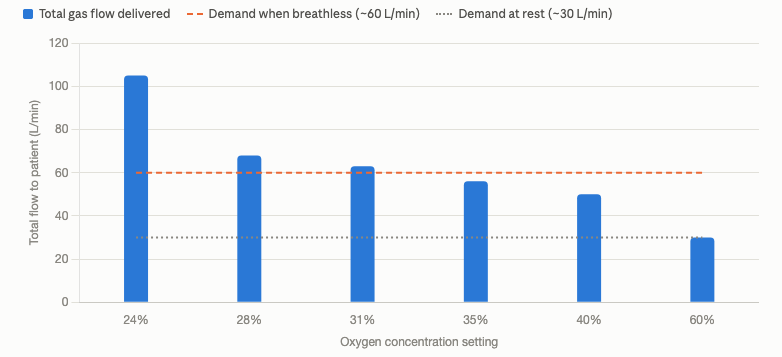
- Accuracy falls at higher settings. Because entrainment drops as FiO2 rises, total flow may no longer exceed the patient’s inspiratory demand above roughly 35% — particularly in someone breathing rapidly. A breathless adult can draw well over 60 L/min at peak inspiration. When total flow falls below that, room air gets pulled in around the mask and the delivered concentration becomes unpredictable. The “fixed performance” promise quietly breaks down at precisely the point of greatest need.
- It interferes with eating, drinking, and talking. Any face mask does, and removal interrupts therapy.
- Comfort and skin integrity. Prolonged wear can cause pressure marks and irritation across the bridge of the nose and cheeks.
- Noise and dryness. The high gas flow is audible and can dry the mouth and nose. Humidification adapters exist but add complexity.
- It requires a high-flow oxygen source. Wall oxygen or a suitably regulated cylinder. This is a large part of why it’s a hospital device.
- Displacement goes unnoticed. If the mask slips, therapy effectively stops, which matters most in drowsy or confused patients.
Why Settings Must Be Clinician-Controlled
Oxygen is a prescribed medication with a therapeutic range, an upper limit, and real potential for harm. Both the valve and the flow rate are set as part of that prescription.
- Too much oxygen is not harmless. In patients at risk of hypercapnic respiratory failure, raising the concentration can drive carbon dioxide up dangerously. Excess oxygen has been associated with worse outcomes in other acute settings too.
- Changing the valve changes the prescription. Swapping a white valve for a green one moves a patient from 28% to 60% — a substantial dose change, not a comfort adjustment.
- Flow and concentration are set together. Altering the flowmeter without accounting for the valve produces a result no one intended.
- Falling oxygen levels are a clinical signal. If saturations are dropping, turning the oxygen up without assessment can mask deterioration rather than treat it. The correct response is escalation to the care team.
In hospital, Venturi setups are typically established by a respiratory therapist or nurse under protocol, with a physician’s prescription specifying the target saturation range.
Monitoring and Care During Use
- Check the mask fits without gaps at the sides, and that the head strap is snug rather than tight.
- Keep the entrainment ports clear. Bedding, clothing, or a hand covering the side ports blocks air entrainment and raises the delivered concentration above what was prescribed.
- Confirm the flowmeter matches the valve at every handover and after any patient transfer.
- Monitor oxygen saturation continuously or at set intervals against the prescribed target, not against 100%.
- Watch for tubing kinks or disconnection, especially after repositioning.
- Inspect pressure points on the nose, cheeks, and behind the ears during longer use.
- Escalate promptly for rising confusion or drowsiness, increasing respiratory rate or effort, or saturations falling outside target.
Key Takeaways
- A Venturi mask delivers a fixed, known oxygen percentage by mixing oxygen with entrained room air, typically 24% to 60%.
- Valve colors vary by manufacturer — always read the percentage printed on the valve itself.
- Each valve has a labeled minimum flow rate, and that flow must be set correctly for the percentage to hold.
- Increasing the flowmeter doesn’t increase the oxygen percentage. Changing the valve does.
- Its main use is controlled oxygen in COPD and others at risk of hypercapnic respiratory failure, often targeting SpO2 of 88–92%.
- It’s not the device for severe hypoxemia — accuracy declines above about 35% in patients breathing hard.
- Valve selection and flow rate are part of an oxygen prescription and are set by clinicians.
Frequently Asked Questions
What oxygen percentage does a Venturi mask deliver?
Typically between 24% and 60%, depending on which valve is fitted. The most common settings are 24%, 28%, 31%, 35%, 40%, and 60%, though kits vary and some include a 50% valve instead of 60%.
What flow rate should a Venturi mask be set to?
Whatever is printed on the valve in use — commonly 2 L/min for 24% up to 15 L/min for 60%. There’s no single correct rate for the mask as a whole; it’s tied to the specific valve. Clinicians sometimes set flow above the labeled minimum for patients breathing rapidly.
Are Venturi mask colors the same across all brands?
No, and assuming they are is a genuine hazard. The common convention is blue 24%, white 28%, yellow 35%, green 60% — but other manufacturers use yellow for 28% and green for 35%. Always read the printed percentage rather than relying on color.
Does turning up the flow rate increase the oxygen percentage?
No. The air-to-oxygen ratio is fixed by the size of the valve’s jet. Raising the flow increases total gas delivered while the concentration stays roughly the same. To change the concentration, the valve is changed.
Why is a Venturi mask used for COPD?
Some people with advanced COPD are at risk of type 2 respiratory failure, where too much oxygen causes carbon dioxide to rise to dangerous levels. Treatment targets a narrow saturation window, commonly 88% to 92%, and hitting that window requires a device that delivers a predictable percentage.
Can a Venturi mask be used at home?
In practice, very rarely. Venturi masks need a high-flow oxygen source, and most home oxygen concentrators can’t sustain the flow rates the higher-percentage valves require. Home oxygen is usually delivered by nasal cannula at low flow. Any home use would be specifically prescribed and set up by a respiratory service, not arranged independently.
Is a Venturi mask better than a non-rebreather mask?
They serve different purposes. A non-rebreather delivers a much higher concentration, roughly 60% to 90%, and is used for severe hypoxemia. A Venturi mask delivers less oxygen but delivers it precisely. Neither is superior — the right choice depends on whether the priority is maximum oxygen or controlled oxygen.
What happens if the side ports get covered?
Blocking the entrainment ports stops room air mixing in, which raises the delivered oxygen concentration above what was prescribed. Bedding, clothing, or a hand resting against the valve can all do this, which is why the ports are kept clear.
Sources
- StatPearls, NCBI Bookshelf, National Library of Medicine. Oxygen Therapy.
- Nursing Skills, NCBI Bookshelf, National Library of Medicine. Oxygen Therapy: Oxygen Delivery Devices.
This article is for general education and doesn’t replace clinical training or medical advice. Oxygen is a prescribed therapy — device settings should only be adjusted by qualified healthcare professionals.
Other Articles You May Find of Interest...
- Candida sp. rRNA Results: What Molecular Testing Detects
- Ant Bites or Poison Ivy? How the Rashes Differ
- Can Stress Cause Cold Sores on the Lips?
- Gram-Positive Rods in a Blood Culture: Contamination or Infection?
- Can Head Lice Get Into Your Ears?
- Staph and Eczema: Why Infected Skin Needs Prompt Care
- Reactive Hepatitis B Surface Antibody: What the Result Means