More Addiction Articles
Signs It’s Time to Consider Professional Help for Addiction or Mental Health

Most people wait far longer than they should before asking for help. Not because the signs are not there, but because the signs are easy to explain away. You tell yourself things have been stressful lately, that a few bad weeks do not mean anything, that other people have it worse. By the time you are ready to admit something might be wrong, the pattern has usually been building for months or years.
The scale of this delay is sobering. According to the 2023 National Survey on Drug Use and Health from the Substance Abuse and Mental Health Services Administration, 58.7 million U.S. adults experienced some form of mental illness in the past year, and 48.5 million people aged 12 or older met the criteria for a substance use disorder. Of those with a substance use disorder, 85.4 percent, or 41.4 million people, did not receive any treatment. The gap between people who need help and people who get help is enormous, and much of that gap comes down to a single question: how do you know when it is actually time?
There is no perfect test, but there are clear patterns that tend to show up before a crisis. Recognizing them early, rather than waiting for something dramatic to force the issue, is often what determines whether a recovery takes hold or keeps getting put off.
Why We Wait Longer Than We Should
Most people who eventually enter treatment can look back and identify the exact moment they first suspected something was wrong. They also remember the reasons they kept quiet. Those reasons tend to cluster around a few predictable patterns, and recognizing them can loosen their grip.
The comparison trap: You measure yourself against the worst-case version of a problem. If you are not drinking in the morning, you cannot have an alcohol problem. If you can still get to work, your depression cannot be that bad. Addiction and mental health conditions exist on a spectrum, and waiting until you meet the extreme version of the diagnosis almost guarantees you will wait too long.
Fear of the label: For many people, being identified as someone with a mental illness or an addiction is harder to sit with than the symptoms themselves, especially in professional or family contexts. A clinical diagnosis is a working description, not a permanent identity, and treatment records are protected by federal privacy law.
The hope it will pass: Almost every mental health or substance use pattern includes stretches where things improve on their own. These natural fluctuations make it easy to believe the underlying issue is resolving. When the pattern returns, often worse than before, the decision to finally seek help gets pushed back again.
There is rarely a single turning point that forces the issue. Mental health and addiction problems usually build through small, incremental changes that feel normal one at a time but look different when you step back and view the last year as a whole. The absence of a dramatic moment is not evidence that help is not needed. For most people, it is simply how these conditions actually progress.
Signs to Watch For With Mental Health
The National Institute of Mental Health identifies several patterns that commonly signal a mental health condition worth taking seriously. What matters is not whether any one sign appears on a single day, but whether a cluster of them is lasting more than two weeks and starting to interfere with your ability to work, sleep, eat, or stay connected to the people you care about.
Mood and emotional shifts: A low, empty, or irritable mood that lasts more than two weeks and does not track to a specific life event is one of the most reliable early signs. The same is true of persistent anxiety or a sense of dread that sits in the background during ordinary moments. Mood shifts are normal. Mood shifts that take up residence are not.
Changes in sleep, appetite, and energy: Sleep and appetite are usually the first systems to show strain. Difficulty falling asleep, sleeping far more than usual, waking exhausted, loss of interest in food, eating for comfort, and unexplained fatigue or physical symptoms like headaches and chronic muscle tension frequently accompany mental health conditions.
Disengagement from your life: Activities that used to feel energizing start to feel flat or pointless. You cancel on friends, avoid phone calls, and pull back from people who matter to you. Work that used to be manageable gets harder to focus on, and small decisions start feeling disproportionately heavy. This combination of anhedonia, withdrawal, and cognitive slowing is often more telling than any single symptom.
Thoughts of self-harm or hopelessness: This is the one that gets its own line. Passing thoughts of not wanting to exist, feeling like the people in your life would be better off without you, or thinking about self-harm require immediate attention. If you are experiencing any of these, call or text 988 to reach the Suicide and Crisis Lifeline. It is free, confidential, and available around the clock.
Signs to Watch For With Substance Use
The diagnostic framework for substance use disorders, summarized in plain language by the National Institute on Alcohol Abuse and Alcoholism, identifies eleven symptoms that cluster into four broad categories. You do not need to meet all eleven to have a problem worth addressing. Even one or two in a category, if they are persistent, are worth paying attention to. The patterns below apply to alcohol and other substances alike.
Impaired control: You use more or for longer than you intended. You have tried to cut back or quit and have not been able to follow through. You experience strong cravings or spend increasing amounts of time obtaining, using, or recovering from use. The gap between your plan and what actually happens is one of the most reliable markers that something has shifted.
Problems at work, home, and in relationships: Responsibilities start slipping. Missed deadlines, declining performance, or lapses in self-care begin to track back to use. Use continues even after it has caused or worsened problems with the people you care about, and activities or friendships that used to matter get deprioritized to make room for use.
Using in risky situations: You use in physically dangerous situations, such as driving or operating equipment. You continue using even though you know it is making a physical or mental health issue worse. The harm does not need to occur for this to be a warning sign. The pattern of accepting the risk is the sign.
Tolerance and withdrawal: You need more of the substance to get the same effect, or the same amount has less effect than it used to. You experience symptoms like shaking, sweating, nausea, anxiety, or insomnia when you stop, or you use to avoid those symptoms. Withdrawal from alcohol and benzodiazepines in particular can be medically dangerous and sometimes fatal without supervision. If you are drinking heavily every day or using benzodiazepines regularly and thinking about stopping, do not stop on your own. Talk to a medical professional first.
When Mental Health and Substance Use Overlap
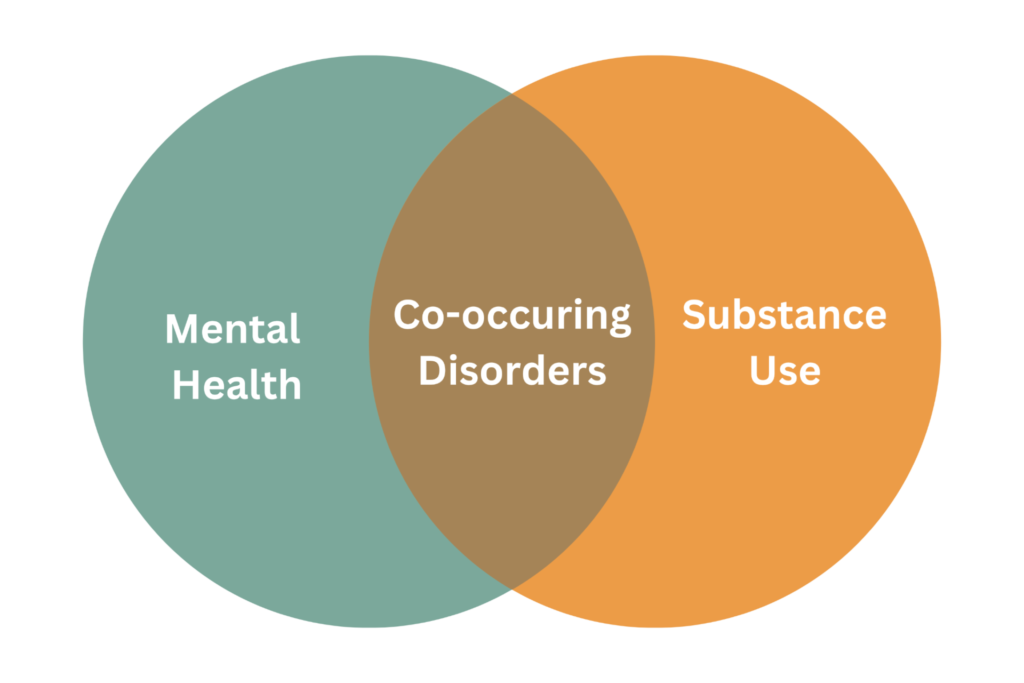
Mental health conditions and substance use disorders frequently show up together. SAMHSA refers to this as co-occurring disorders, and it is common enough that any serious treatment program is built to address both at once. The relationship usually runs in both directions. Someone with untreated anxiety, depression, or unresolved trauma may start using alcohol or another substance to take the edge off, and over time that pattern hardens into dependence. Someone with a substance use disorder may develop depression, anxiety, or cognitive changes as a direct result of prolonged use, especially when sleep, nutrition, and relationships all start to deteriorate.
When both conditions are active, each tends to make the other worse and harder to treat. Untreated depression makes relapse more likely. Active substance use makes depression harder to stabilize. Trying to address only one side usually means the untreated side eventually pulls the person back into the cycle.
The clinical response to this is called dual diagnosis or integrated treatment. A good integrated program uses the same clinical team and treatment plan to address both conditions at once, which is generally more effective than stitching together separate providers for each issue. If you are recognizing signs from both lists in this article, that is useful information rather than more discouraging news. It means an integrated approach is likely to be a better fit from the start.
What Professional Help Actually Looks Like
Professional help is not a single thing. It is a range of options matched to the severity of the issue, the structure of your life, and what has or has not worked in the past. You do not need to know in advance which level of care you need. A qualified assessment will help sort that out.
Most treatment begins with a clinical assessment, which is simply a structured conversation with a licensed clinician. For mental health care in particular, this initial conversation is often the only step someone takes for a while, and that can be entirely appropriate. There is no obligation to enter a program just because you have had an evaluation.
For mild to moderate concerns, weekly outpatient therapy with a licensed clinician is often the right starting point. Cognitive behavioral therapy, dialectical behavior therapy, and trauma-focused modalities like EMDR are all well-researched approaches with strong track records. When weekly therapy is not enough but residential care is not necessary, intensive outpatient programs and partial hospitalization offer more structure while letting you continue living at home.
For more severe or complex situations, residential treatment provides full-immersion care. Residential programs for substance use in particular create a pause from the environment where the problem developed, which is often what allows real change to take root. Residential care is not a last resort. It is a tool matched to the size of the challenge, and for many people it is the level of care that finally makes treatment stick.
Medication management, when appropriate, can meaningfully reduce symptoms alongside therapy. Aftercare, sober living, alumni programs, and continued therapy all play a role in long-term recovery. The specific combination varies, but the principle is consistent: the longer someone stays engaged with support after formal treatment ends, the better the outcomes tend to be.
Taking the First Step

You do not need to have the whole picture figured out before you reach out. A primary care doctor, a licensed therapist, an employee assistance program through work, or a free and confidential helpline like SAMHSA’s National Helpline at 1-800-662-HELP (4357) are all valid starting points. The goal of the first conversation is not to commit to anything. It is to get a clearer view of what you are dealing with and what the options are.
If a treatment program ends up being the right next step, admissions at a reputable provider generally begins with a short, confidential phone conversation and a clinical assessment. Most providers will walk through insurance coverage, scheduling, and what the first few days or weeks actually look like before you are asked to make any commitment.
If there is one thing worth remembering from this article, it is this. The sign that you need help is almost never a single dramatic moment. It is the quiet accumulation of smaller signs that you have been explaining away. Taking those signs seriously sooner, rather than later, is what most often makes the difference between a long, slow deterioration and a recovery that actually takes hold.
You are allowed to ask for help before things get worse. That is not weakness. That is exactly how the process is supposed to work.
Other Articles You May Find of Interest...
- When Addiction and Mental Illness Arrive Together: What Families Should Know Before They Intervene
- How Lived Experience Can Support a More Human Approach to Addiction Care
- From Recovery Goals to Real-Life Progress
- How Can Daily Habits Help People Rebuild Stability During Addiction Recovery?
- When Pain, Anxiety, and Opioid Use Overlap: Why Treating Only One Problem Can Backfire
- What Codependency Actually Describes, and Why It Is Not a Diagnosis
- 8 Nicotine Pouch Flavors to Consider When Moving Away From Cigarettes