More Health News & Research Articles
pLI1-3: An Experimental Peptide Being Studied for Hyperhidrosis
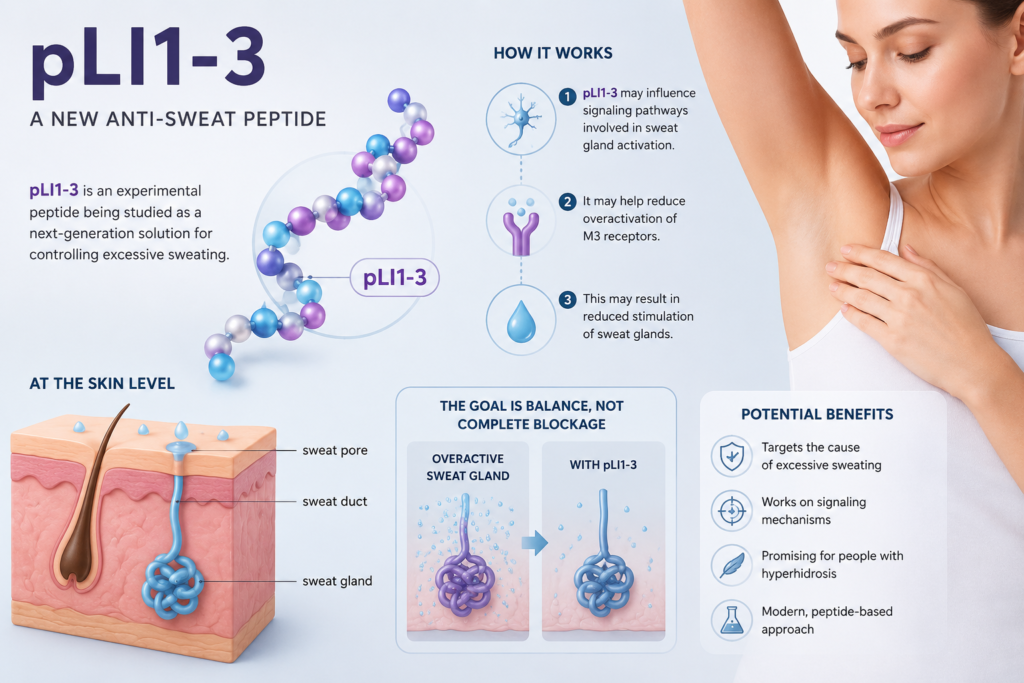
Excessive sweating is a problem that people rarely talk about openly, yet it can affect confidence, appearance, and quality of life every single day. Wet underarms, sweaty palms, marks on clothing, discomfort in social situations, and the constant need to control yourself — all of this is familiar to people with hyperhidrosis.
Traditional sweat-control products usually work on the surface: some mask odor, while others temporarily block the sweat ducts. But modern science is increasingly looking deeper — not only at sweat itself, but also at the mechanisms that trigger its production.
One area of ongoing research involves the experimental peptide pLI1-3.
What is pLI1-3?
pLI1-3 is an experimental next-generation peptide being studied as a potential solution for controlling excessive sweating. Its proposed mechanism differs from traditional deodorants and antiperspirants. Rather than masking odor or mechanically blocking sweat ducts, researchers are studying whether it may influence signaling pathways involved in sweat gland activation.
In simple terms, pLI1-3 is considered a peptide that may help reduce the excessive activity of the mechanisms that trigger sweating.
Because of this research, pLI1-3 has been described as an experimental anti-sweat peptide under investigation for hyperhidrosis.
Why this matters for hyperhidrosis
Hyperhidrosis is a condition in which sweating becomes excessive and does not always match temperature, physical activity, or the body’s actual need for cooling. A person may feel cool and be at rest, yet the sweat glands can still remain overly active.
The problem most commonly affects the underarms, palms, feet, face, back, and chest.
For many people, this is not just a cosmetic issue. Excessive sweating can affect clothing choices, work, sports, dating, business meetings, and everyday communication. A person may start avoiding handshakes, light-colored T-shirts, public speaking, and any situation where sweat could become visible.
That is why interest in new sweat-control solutions continues to grow.
How pLI1-3 is connected to sweat glands
Sweat glands are activated through a complex system of nerve and biochemical signals. One of the key mechanisms is associated with acetylcholine and muscarinic receptors, including M3 receptors.
When this pathway is activated too intensely, the sweat glands may become overactive. pLI1-3 is being studied as a peptide that may interfere with this signaling cascade and reduce excessive stimulation.
The main idea behind pLI1-3 is not simply to “turn off” sweat, but to work closer to the cause of excessive sweating.
How pLI1-3 differs from regular antiperspirants
Regular antiperspirants most often contain aluminum salts. They work locally: they interact with sweat and temporarily reduce its release onto the skin surface. For many people this is enough, but in cases of pronounced hyperhidrosis, the effect may be weak or unstable.
pLI1-3 is being investigated as a different approach. It is a peptide-based technology aimed at signaling mechanisms involved in sweat gland activation. This approach is being investigated as a potential option for people who do not achieve adequate results with standard antiperspirants.
Why pLI1-3 is called an anti-sweat peptide
pLI1-3 is called an anti-sweat peptide because it is being studied specifically in the context of reducing excessive sweating. In scientific discussions, it is considered a potential candidate for further development of anti-hyperhidrosis solutions.
This has generated interest in pLI1-3 as a potential area of future research.
It is important to understand that pLI1-3 is not just a cosmetic ingredient “for freshness.” Its value lies in its connection to the biological mechanisms of sweating.
Who may be interested in pLI1-3?
pLI1-3 may be of interest to people who experience:
- excessive underarm sweating;
- sweaty palms;
- sweaty feet;
- sweat marks on clothing;
- discomfort in heat, during stress, or physical activity;
- the feeling that regular deodorants and antiperspirants are not effective enough.
pLI1-3 may be especially interesting for those looking for a more modern approach to sweat control.
Conclusion
pLI1-3 is an experimental peptide being studied as a potential approach to managing excessive sweating. For people who have long been looking for a modern sweat-control solution, pLI1-3 may contribute to future research and development of new approaches for hyperhidrosis.
Other Articles You May Find of Interest...
- pLI1-3: An Experimental Peptide Being Studied for Hyperhidrosis
- 5 Things To Know Before Buying Laboratory-Grade Amino Acid Chains for Scientific Use
- Understanding Research Peptides: What Laboratories Actually Use Them For
- Why Purity Testing Matters When Comparing Peptide Suppliers
- How to Evaluate Research Peptide Companies in 2026
- BPC-157 Canada Research Guide 2026: Sourcing, Research, and Compliance
- How to Reconstitute Peptides: Complete Guide for 2026