






More Workplace Health & Safety Articles
Why Mask Fit Testing Matters and Why It’s Required, Mandatory, and Important for Respirator Safety
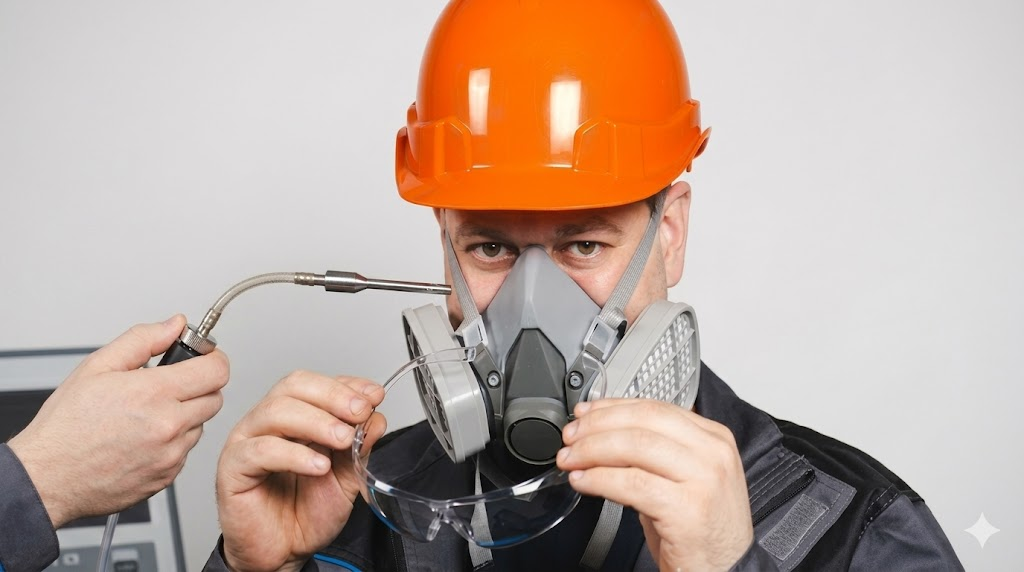
When a worker puts on a mask, they expect it to protect them. But expectation and reality can differ sharply if the mask doesn’t fit correctly. A mask that leaks even slightly renders its filtration media almost irrelevant. Contaminated air simply bypasses the filter entirely, flowing through gaps around the nose, chin, or cheeks. This is why mask fit testing is not just a best practice: it is a legally enforceable obligation under Work Health and Safety (WHS) legislation and the AS/NZS 1715:2009 standard.
This article explains what fit testing is, why it is required, how it is conducted, and what happens when it is ignored giving health and safety managers, supervisors, and workers the knowledge they need to stay protected and compliant.
1. What is Mask Fit Testing?
Fit testing is a formal, standardised process used to verify that a particular make, model, and size of tight-fitting mask forms an adequate seal on an individual wearer’s face. No two faces are alike. Differences in facial bone structure, nose shape, jaw width, scarring, and even weight change can all affect how well a facepiece seats against skin.
Importantly, fit testing is distinct from a “fit check” (sometimes called a seal check), which is a quick user-performed test carried out each time a mask is donned. A fit check confirms the mask is being worn correctly at that moment. Fit testing, by contrast, is a formal procedure conducted by a competent person using validated methods and produces documented evidence that a specific mask is appropriate for a specific individual.
2. The Regulatory and Standards Framework
The obligation to conduct fit testing arises from multiple layers of legislation and standards that apply across most industries where respiratory hazards exist.
2.1 WHS Legislation
Under the model Work Health and Safety Act and its Regulations, persons conducting a business or undertaking (PCBUs) must manage risks to health and safety so far as is reasonably practicable. Where respiratory hazards cannot be eliminated or adequately controlled by engineering means, respiratory protective equipment (RPE) must be provided, and it must be effective. AS/NZS 1715:2009 — Selection, Use and Maintenance of Respiratory Protective Equipment — is the nationally referenced standard that defines what ‘effective’ means in practice, and fit testing sits at its core.
2.2 AS/NZS 1715:2009
Clause 4.5 of AS/NZS 1715:2009 mandates that all wearers of tight-fitting respirators (including P2/N95 disposables, half-face and full-face reusable respirators, and powered air-purifying respirators with tight-fitting facepieces) must be fit tested before first use and periodically thereafter. The standard makes clear that fit testing is not optional: it is a prerequisite for any tight-fitting respirator program to be considered compliant.
| Key Standard: AS/NZS 1715:2009 — Clause 4.5 requires fit testing for all tight-fitting respirator wearers. Non-compliance can constitute a breach of WHS duties and expose PCBUs to significant penalties. |
2.3 Industry-Specific Requirements
Several industries face additional regulatory obligations. In construction and demolition, silica dust exposure — now classified as a high-risk respiratory hazard — requires demonstrably effective RPE programs that include fit testing. In healthcare settings, fit testing of P2/N95 respirators became widely required following infection control guidance updates. In mining, asbestos removal, and chemical manufacturing, regulators have long required documented fit testing as part of site safety plans.
3. Types of Fit Testing
AS/NZS 1715:2009 recognises two validated approaches to fit testing: qualitative and quantitative. Each has appropriate applications, and selection depends on the respirator type, available equipment, and required protection level.
| Feature | Qualitative (QLFT) | Quantitative (QNFT) |
| Method | Pass/fail sensory test | Instrumented measurement |
| Equipment Needed | Test kit (saccharin, bitrex) | Portacount or similar |
| Respirator Types | Half-face disposable & reusable | All tight-fitting types |
| Cost | Lower | Higher |
| Accuracy | Subjective | Objective (fit factor) |
| AS/NZS Compliance | Accepted for P1/P2 | Required for P3 & PAPR |
3.1 Qualitative Fit Testing (QLFT)
Qualitative fit testing uses the wearer’s sensory response — typically taste or smell — to detect test agent penetration. The most common agents are saccharin solution (sweet taste) and Bitrex (bitter taste). The wearer dons the respirator, enters a test hood or enclosure, and is asked to perform a series of exercises (normal breathing, deep breathing, head movement, bending, talking) while the test agent is introduced. If the wearer detects the agent, the test fails.
QLFT is a pass/fail test; it does not produce a numeric fit factor. It is suitable for half-face respirators where the minimum acceptable fit factor is 100 (protection factor 10). It is not appropriate for full-face respirators or any application requiring a fit factor above 100.
3.2 Quantitative Fit Testing (QNFT)
Quantitative fit testing uses instrumentation to measure actual particle concentrations inside and outside the facepiece simultaneously, producing a numeric fit factor. A fit factor of 100 or greater is required for half-face respirators; 500 or greater is required for full-face respirators. Devices such as the TSI PortaCount use condensation particle counting to achieve this measurement.
QNFT is considered more objective and is required for full-face respirators, powered air-purifying respirators (PAPR) with tight-fitting facepieces, and supplied air respirators. It is also preferred in high-hazard environments where objective documentation is essential for legal and insurance purposes.
4. Who Needs Fit Testing and How Often?
Anyone who is required to wear a tight-fitting respirator as part of their role must be fit tested. This includes, but is not limited to:
- Workers in construction, demolition, and renovation where silica or asbestos may be present
- Healthcare and laboratory workers handling infectious aerosols or hazardous chemicals
- Mining, tunnelling, and quarrying personnel exposed to dust and diesel particulates
- Emergency response and hazmat personnel
- Painters, spray applicators, and workers using solvents or isocyanates
- Asbestos removal workers and supervisors
4.1 Frequency of Fit Testing
AS/NZS 1715:2009 requires that fit testing be repeated:
- Before a worker uses a different make, model, or size of respirator
- When there are changes to the worker’s facial structure — due to significant weight gain or loss, facial surgery, significant dental work, or scarring
- At regular intervals as part of the RPE program, typically every two years as a minimum, though higher-hazard programs may require annual retesting
- When a supervisor or occupational hygienist has reason to believe the seal may have been compromised
| Important Note: A fit test is NOT transferable between workers. Each individual must be tested in the specific respirator they will use. Group testing with a single ‘representative’ unit is non-compliant. |
5. The Consequences of Skipping Fit Testing
The consequences of neglecting fit testing fall into three broad categories: health outcomes, legal liability, and operational risk.
5.1 Health Consequences
An ill-fitting respirator provides a false sense of security. Workers believe they are protected while harmful substances — silica dust, asbestos fibres, biological aerosols, chemical vapours — are being inhaled around the seal. Occupational diseases linked to inadequate respiratory protection include silicosis, mesothelioma, occupational asthma, and hypersensitivity pneumonitis, many of which are irreversible and ultimately fatal. The latency period of these diseases means that by the time symptoms appear, extensive and permanent damage may already have occurred.
5.2 Legal and Regulatory Consequences
Failure to conduct fit testing where required is a breach of WHS duties. Regulators have the authority to issue Improvement Notices, Prohibition Notices, and prosecute PCBUs and officers. Under the model WHS Act, Category 1 offences (reckless conduct causing serious risk) carry penalties of up to $3 million for corporations. Even for lower categories, the combination of fines, reputational damage, and workers’ compensation liability represents a severe business risk.
5.3 Workers’ Compensation and Insurance
If a worker develops an occupational lung disease and it can be demonstrated that the PCBU failed to conduct fit testing, insurers may dispute or reduce coverage. Courts have found that non-compliance with applicable standards is evidence of negligence, significantly strengthening workers’ compensation claims.
6. Practical Guidance for Compliance
6.1 Engage a Competent Fit Tester
Fit testing must be conducted by a competent person — someone with the training, knowledge, and experience to perform the test accurately using validated equipment and protocols. This may be a trained in-house safety officer or an external occupational hygienist. All test records must be retained and made available for inspection.
6.2 Document Everything
Records must include the worker’s name, the respirator make, model, and size, the test method, the result (fit factor or pass/fail), the date, and the tester’s name. These records serve as both compliance evidence and baseline data for future retesting.
6.3 Pair Fit Testing with a Comprehensive RPE Program
Fit testing is one element of a broader Respiratory Protective Equipment program. That program must also include: hazard identification and risk assessment, correct respirator selection (matching protection factor to contaminant), user training on donning, doffing, and seal checking, cleaning and maintenance protocols, storage requirements, and regular program review.
Conclusion
Mask fit testing is not a bureaucratic formality — it is the critical link between equipment specification and actual worker protection. A respirator that does not fit is not a respirator; it is a placebo. Given the irreversible nature of most occupational respiratory diseases, and the clear legal obligations under WHS legislation and AS/NZS 1715:2009, there is no defensible reason to delay or skip this process.
Safety managers and PCBUs should review their current RPE programs, identify workers who require fit testing, engage competent testers, and ensure records are current and complete. In doing so, they not only meet their legal obligations — they make a genuine, measurable difference to the long-term health of their workforce.
| Applicable Standards: AS/NZS 1715:2009 — Selection, Use and Maintenance of Respiratory Protective Equipment | AS/NZS 1716:2012 — Respiratory Protective Devices | Model WHS Act and Regulations |
Other Articles You May Find of Interest...
- How Workplace Health Programs Support Business Growth
- How Walking Pads Can Help People Stay Active at Work
- Safety and Skill at the Heart of Australia’s Construction and Logistics Industries
- Building Safer Workplaces: Why High-Risk Equipment Training Matters in Australia
- How Commercial Kitchen Organization Can Support Food Safety and Reduce Workplace Injury Risk?
- How to Remove Odors from Offices in Singapore
- Why Does Your Ebike Feel Uncomfortable? Check These Things Before You Blame the Bike




